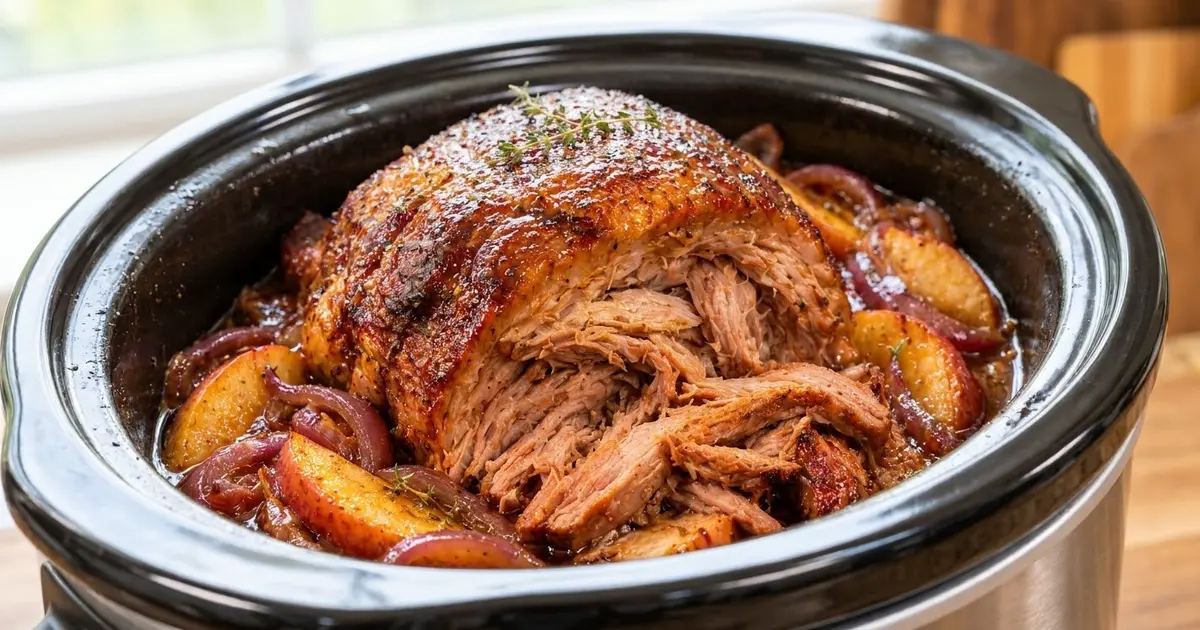
Some dinners cook themselves, and this is one of them. A boneless pork shoulder gets rubbed with a simple mix of brown sugar, paprika, and herbs, then seared until deeply browned. It goes into the slow cooker on a bed of red onions and apple wedges and braises for hours until it falls apart when you touch it with a fork.
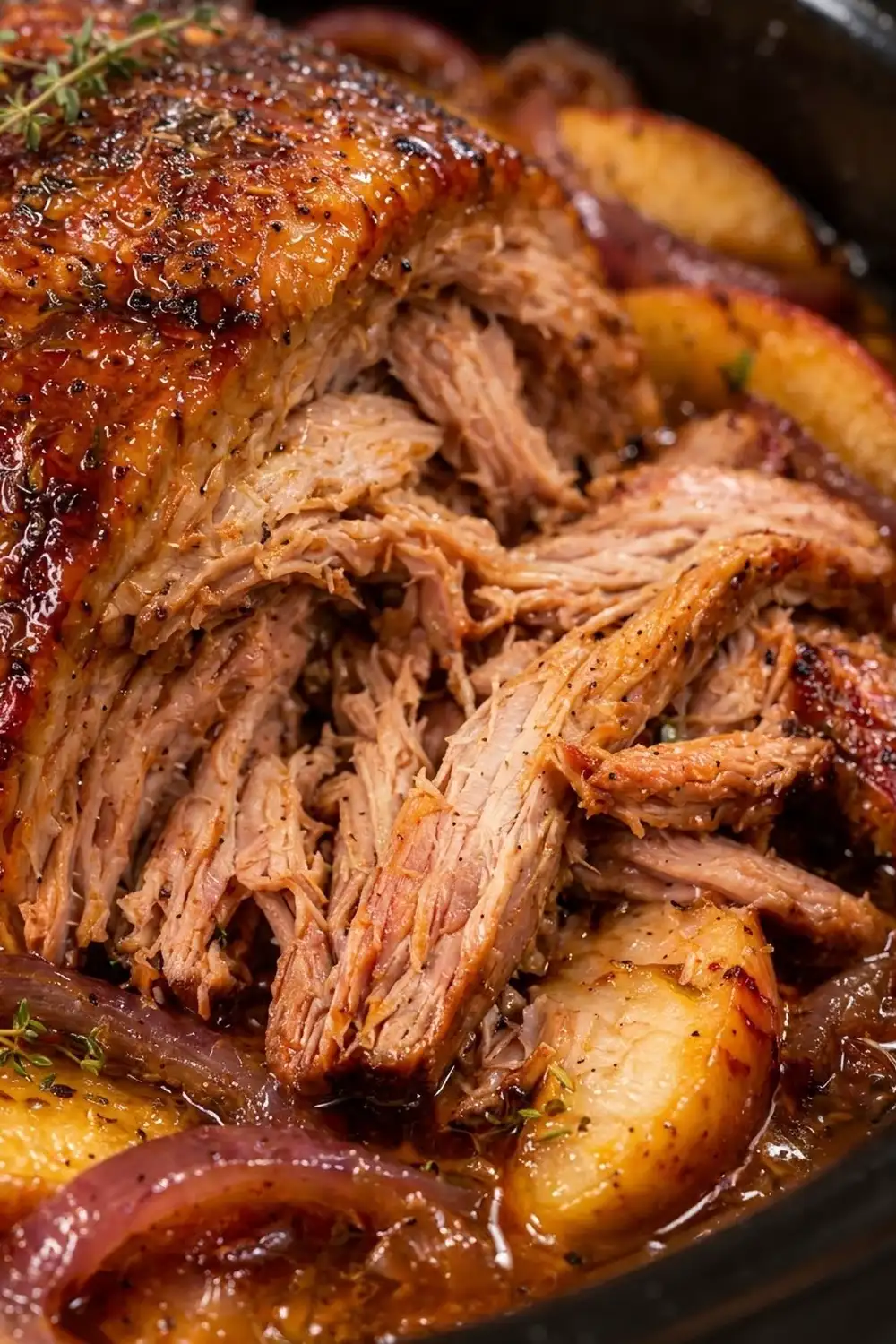
The result smells like a fall afternoon. The crust turns glossy and caramelized, the meat underneath is so tender it pulls into long, juicy shreds, and the apples soften into sweet, almost jammy wedges. The red onions melt into the cooking liquid and turn it into a savory-sweet sauce you’ll want to spoon over everything.
Home cooks will love how little hands-on work this takes. You spend about 25 minutes seasoning, searing, and slicing, and the slow cooker does everything else. There’s no babysitting, no oven to watch, and the whole meal stays warm until everyone is ready to eat.
It’s a great fit for Sunday suppers, holiday gatherings, and feeding a crowd. It also works well for meal prep, since leftovers reheat beautifully and turn into sandwiches, bowls, and tacos all week. It’s naturally gluten-free and dairy-free, too.
Why This Recipe Works
Searing builds the crust. Pork shoulder will turn tender in a slow cooker no matter what, but it won’t brown there. Searing it first in a hot skillet triggers the Maillard reaction, which creates that dark, flavorful crust you see on the finished roast. A little brown sugar in the rub caramelizes in the pan and helps the outside stay glossy and mahogany-colored even after hours of braising.
Shoulder is the right cut. Pork shoulder (also called pork butt) is marbled with fat and connective tissue. Over a long, gentle cook, that collagen breaks down into gelatin, which keeps the meat moist and gives the sauce body. Leaner cuts like loin would dry out and turn stringy over 8 hours.
Apples and onions do double duty. Placed under and around the roast, they act as a rack that keeps the meat from stewing on the bottom. As they cook, they release sugar and juice into the pot, so you only need a small amount of added liquid. Firm apples hold their wedge shape instead of turning to applesauce, and a splash of cider vinegar keeps the sauce balanced so it doesn’t taste too sweet.
Tips for Success
- Trim, but not too much. Cut away thick hard fat, but keep a ¼-inch (6 mm) cap on top to baste the meat during cooking.
- Use firm apples. Soft varieties like McIntosh will collapse into sauce. Honeycrisp, Gala, Fuji, and Pink Lady keep their shape.
- Cut the onions thick. Slices about ½ inch thick soften without disappearing completely over 8 hours.
- Don’t add extra liquid. It may look dry at first, but the apples, onions, and pork release a lot of juice. Too much liquid makes the sauce thin and watery.
- Thicken the sauce if you like. Stir 1 tbsp (8 g) cornstarch into 2 tbsp (30 ml) cold water, add it to the strained juices in a saucepan, and simmer for 2 minutes until glossy.
- Make it ahead. Season the pork the night before and refrigerate it uncovered. This dry-brines the meat and seasons it all the way through.
- No skillet? Use the oven. Broil the seasoned roast 4 inches (10 cm) from the heat for 4–5 minutes per side to brown it before slow cooking.
- Check with a thermometer. For shreddable pork, aim for 200°F (93°C) or higher. At 145°F (63°C) the pork is safe to eat but still too firm to pull apart.
Variations
Maple-Mustard Pork. Replace the brown sugar in the rub with 2 tbsp (30 ml) maple syrup brushed on after searing. Whisk 2 tbsp (30 g) Dijon mustard into the cider. You’ll get a tangy, slightly sharp sauce that goes well with the sweet apples.
Pears Instead of Apples. Swap in firm Bosc or Anjou pears cut into the same wedges. They taste gentler and more floral than apples, and they soften a little more, so add them halfway through if you want them to hold their shape.
Spiced Autumn Version. Add 1 cinnamon stick, ½ tsp (1 g) ground allspice, and 3 whole cloves to the braising liquid. The sauce gets a warm, holiday flavor that’s great for a festive dinner.
Herb and Garlic. Leave the brown sugar out of the rub and add 6 smashed garlic cloves and 2 sprigs of fresh rosemary to the pot. This gives you a more savory roast with an herby aroma, and the apples still add a bit of sweetness.
FAQ
Do I really need to sear the pork?
You don’t have to, but searing makes a noticeable difference. Without it, the pork will still be tender, but it’ll look pale and taste flatter. The dark, glossy crust in the finished dish comes from those 15 minutes in the skillet.
Can I use pork loin instead of shoulder?
Not for this recipe. Pork loin is very lean and will turn dry and chalky over a long slow cook. If loin is all you have, cook it on LOW for just 4–5 hours to 145°F (63°C) and slice it instead of shredding it.
Can I cook it from frozen?
No. A frozen roast spends too long in the unsafe temperature range of 40–140°F (4–60°C) inside a slow cooker. Thaw it in the refrigerator for 24–36 hours before seasoning.
Why is my pork tough after 8 hours?
Tough shoulder almost always needs more time. Collagen only starts breaking down above about 190°F (88°C), and slow cookers run at different temperatures. Keep cooking in 30-minute intervals until it shreds easily.
Will the apples turn mushy?
Firm apples with the skin on will soften but keep their wedge shape over 8 hours on LOW. On HIGH, or with softer apple varieties, they can break down more. If you want firmer apples, add the top layer during the last 2 hours.
Storage and Reheating
Let leftovers cool, then store the pork, apples, onions, and some of the cooking liquid together in an airtight container. Keeping the meat in its juices stops it from drying out. It will keep in the refrigerator for up to 4 days.
To reheat, warm portions in a covered saucepan over medium-low heat with a few spoonfuls of the juices for 8–10 minutes, stirring now and then. In the microwave, cover the dish and heat in 1-minute bursts, stirring between each one.
The pork freezes well for up to 3 months. Freeze it in portions with plenty of liquid, and leave ½ inch (1.25 cm) of headspace in the container. The apples will get softer after freezing but still taste good. Thaw overnight in the refrigerator before reheating.
Serving Suggestions
Serve the pork over creamy mashed potatoes so they can soak up all the apple-onion juices. Roasted carrots or Brussels sprouts add an earthy, slightly crisp side to balance the soft, sweet braise. A simple green salad with a sharp vinaigrette cuts through the richness.
For a casual meal, pile the shredded pork and some soft onions onto toasted brioche buns. The slightly sweet bread goes perfectly with the caramelized crust and tender meat.
Final Notes
This slow cooker pork roast with apples and onions is the kind of recipe that makes you look like you worked hard when you really didn’t. Twenty-five minutes of seasoning and searing in the morning gets you a fragrant, fall-apart roast by dinnertime, with sweet apples, soft red onions, and a sauce that tastes like it simmered all day, because it did. Make it once and it may well become part of your regular fall and winter rotation. Enjoy every tender bite.
Print
Slow Cooker Pork Roast with Apples and Onions Recipe
- Total Time: 8 hours 25 minutes
- Yield: 8 1x
Description
A seared pork shoulder slow-cooked on a bed of red onions and apple wedges until it’s fall-apart tender. It’s an easy, cozy dinner that cooks itself.
Ingredients
- 2 tbsp (25 g) packed light brown sugar
- 2 tsp (12 g) kosher salt
- 1 tsp (2 g) freshly ground black pepper
- 2 tsp (5 g) smoked or sweet paprika
- 1 tsp (3 g) garlic powder
- 1 tsp (1 g) dried thyme
- 1 boneless pork shoulder (pork butt), about 4 lb (1.8 kg)
- 2 tbsp (30 ml) vegetable or olive oil
- 2 large red onions (about 1 lb / 450 g total), cut into ½-inch (1.25 cm) slices
- 3 medium firm red apples, such as Honeycrisp, Gala, or Fuji (about 1½ lb / 680 g), cored and cut into 8 wedges each
- 1 cup (240 ml) apple cider or unsweetened apple juice
- 2 tbsp (30 ml) apple cider vinegar
- 4–5 sprigs fresh thyme, plus more for garnish
Instructions
- Season the pork. Pat the pork shoulder very dry with paper towels on all sides. In a small bowl, stir together the brown sugar, salt, pepper, paprika, garlic powder, and dried thyme. Rub the mixture all over the roast, pressing it into the surface and into any folds. The pork should be evenly coated with a reddish-brown, speckled layer. Don’t skip drying the meat; surface moisture turns the rub into a paste that steams instead of browning. If you have time, let the seasoned roast sit at room temperature for 20 minutes before searing.
- Sear the roast. Heat the oil in a large skillet over medium-high heat until it shimmers and moves easily across the pan. Add the pork fat-side down and sear for 3–4 minutes per side, turning with tongs, until every surface has a deep mahogany crust. You should hear a steady, strong sizzle the whole time. A common mistake is moving the meat too soon. If it sticks, it isn’t ready to turn yet. Watch the heat too: the sugar in the rub can scorch, so lower the heat slightly if the pan starts to smoke heavily.
- Deglaze the pan. Take the pork out of the skillet and set it aside on a plate. Pour the apple cider and vinegar into the hot pan and scrape up all the browned bits from the bottom with a wooden spoon. Let it bubble for about 1 minute. The liquid will turn a rich amber color and smell sweet and toasty. Those browned bits hold a lot of flavor, so don’t leave them in the pan. Don’t let the liquid boil away, though; you need nearly all of it in the slow cooker.
- Layer the onions and apples. Scatter about two-thirds of the red onion slices and half the apple wedges across the bottom of the slow cooker insert. Set the seared pork on top, fat-side up. Tuck the remaining onions, apples, and thyme sprigs around the sides of the roast, then pour the deglazing liquid around (not over) the meat. Pouring liquid directly on top washes away the crust you just built. The liquid should come only about an inch up the sides, since the apples and onions will release plenty of juice as they cook.
- Slow cook until tender. Cover and cook on LOW for 8 hours or HIGH for 5 hours. The pork is done when a fork slides in with no resistance and the meat starts pulling apart on its own, around 200–205°F (93–96°C) inside. Your kitchen will smell sweet and savory. Resist lifting the lid during cooking. Each peek lets out heat and can add 15–20 minutes to the cook time. If the roast resists the fork, give it another 30–60 minutes; it isn’t overcooked, it just needs more time.
- Shred and garnish. Turn off the slow cooker and let the pork rest in the liquid for 10–15 minutes. Then use two forks to pull one end of the roast apart into thick, juicy shreds. You can shred the whole thing or leave part of it whole for a nicer look when serving. Spoon off any fat pooled on the surface, discard the cooked thyme stems, and top with fresh thyme sprigs. Don’t drain the pot. Letting the shredded meat soak up the apple-onion juices keeps it moist.
Notes
- Trim, but not too much. Cut away thick hard fat, but keep a ¼-inch (6 mm) cap on top to baste the meat during cooking.
- Use firm apples. Soft varieties like McIntosh will collapse into sauce. Honeycrisp, Gala, Fuji, and Pink Lady keep their shape.
- Cut the onions thick. Slices about ½ inch thick soften without disappearing completely over 8 hours.
- Don’t add extra liquid. It may look dry at first, but the apples, onions, and pork release a lot of juice. Too much liquid makes the sauce thin and watery.
- Thicken the sauce if you like. Stir 1 tbsp (8 g) cornstarch into 2 tbsp (30 ml) cold water, add it to the strained juices in a saucepan, and simmer for 2 minutes until glossy.
- Make it ahead. Season the pork the night before and refrigerate it uncovered. This dry-brines the meat and seasons it all the way through.
- No skillet? Use the oven. Broil the seasoned roast 4 inches (10 cm) from the heat for 4–5 minutes per side to brown it before slow cooking.
- Check with a thermometer. For shreddable pork, aim for 200°F (93°C) or higher. At 145°F (63°C) the pork is safe to eat but still too firm to pull apart.
- Prep Time: 25 minutes
- Cook Time: 8 hours on LOW (or 5 hours on HIGH)
- Category: Dinner