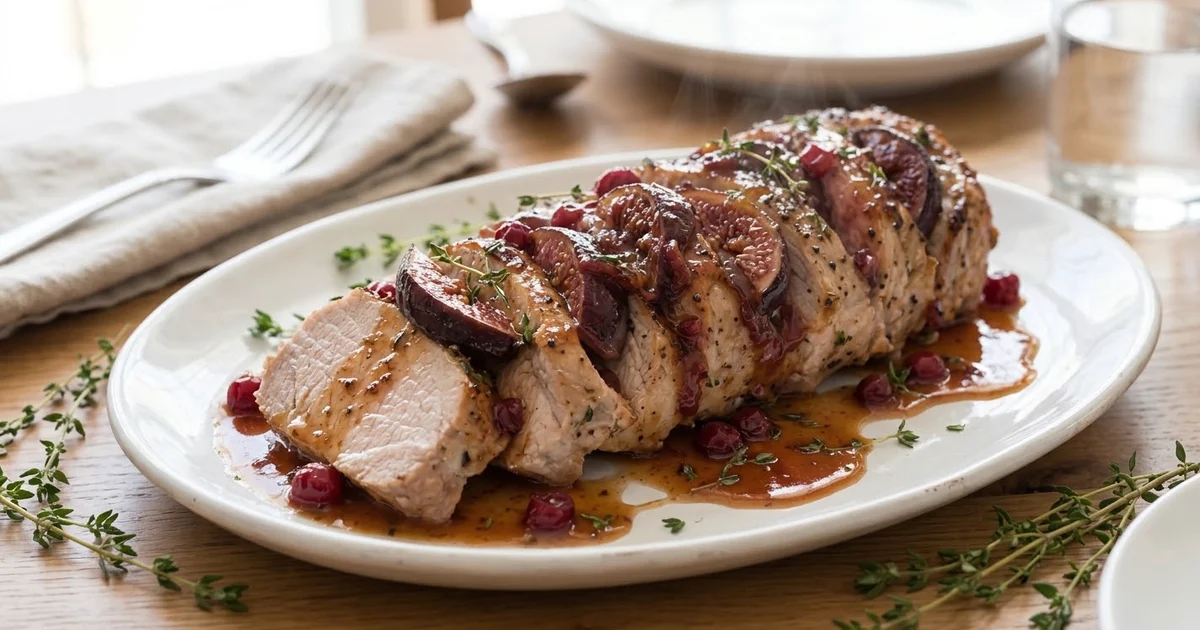
This slow cooker fig and thyme pork loin looks like a lot of work, but it’s mostly waiting. You cut a pork loin into deep slices without cutting all the way through, tuck a fresh fig half into every slice, season it with pepper and thyme, and pour a honey-balsamic glaze over the top. Then the slow cooker does the rest.
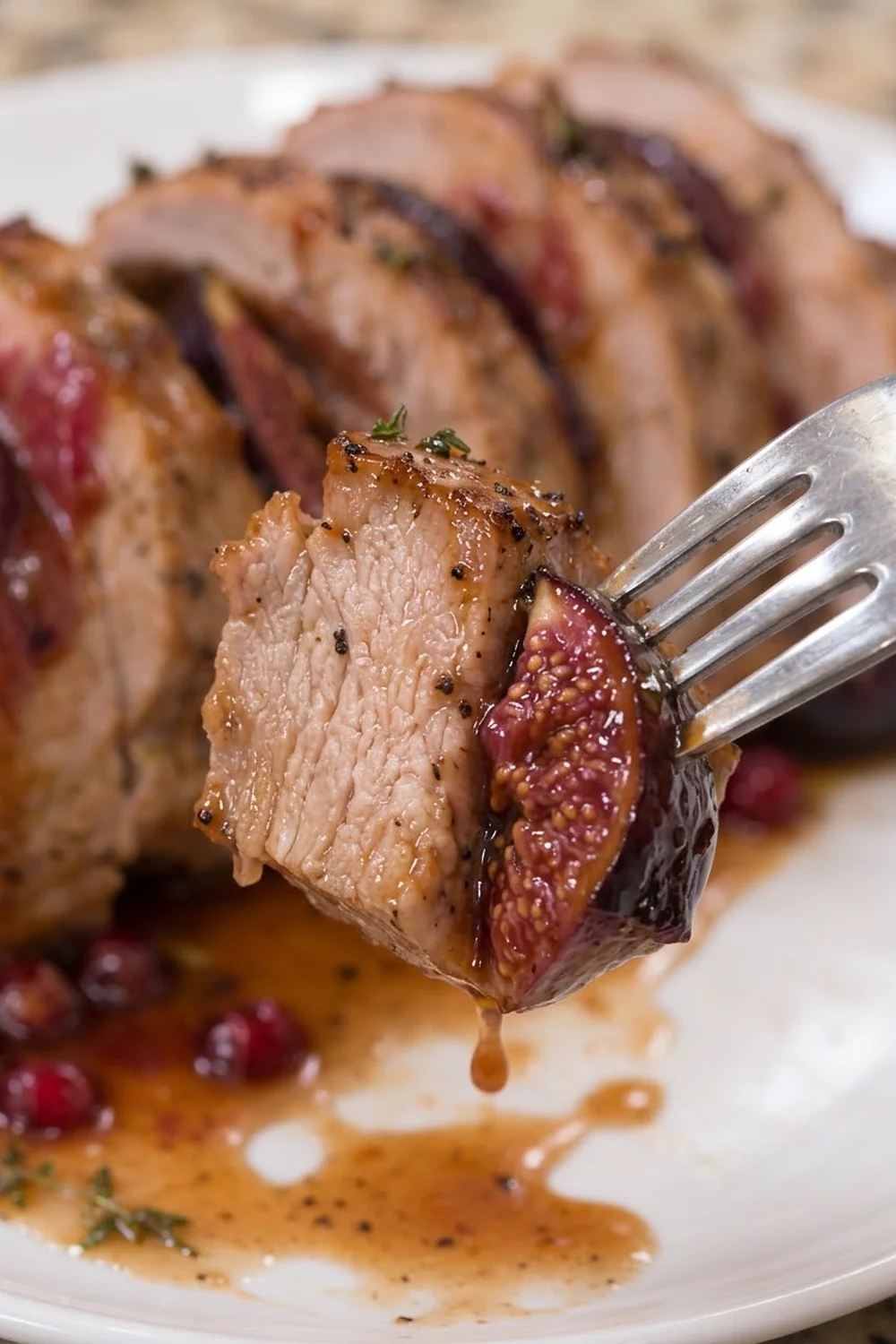
Once the lid comes off, the kitchen smells of caramelized honey, warm thyme and sweet roasted fruit. The pork stays tender and juicy, and the slices pull apart easily with a fork. The figs turn soft and jammy. The cranberries burst into the pan juices and add a bright, tart edge, so the sauce tastes rich without being heavy.
For a home cook, this recipe is great because it’s hard to get wrong. Nothing needs searing and you don’t have to watch the oven. The deep cuts let the seasoning and glaze get into the middle of the roast, so every slice is flavored, not just the outside.
It’s a good fit for Sunday dinner, holiday gatherings and casual entertaining, because it feeds eight people and looks impressive on the table. It’s also naturally gluten-free and dairy-free, and leftovers make excellent sandwiches and grain bowls for the rest of the week.
Why This Recipe Works
The hasselback cuts do most of the work. Cutting the loin into 1-inch (2.5 cm) slices most of the way through gives you far more surface area. Seasoning and glaze can reach the center of the roast instead of only the outside. The cuts also hold the figs in place, so the fruit flavors the meat from inside, and each portion comes with its own fig when you serve it.
Low, moist heat suits a lean cut. Pork loin has little fat, so it can dry out quickly in a hot oven. On LOW in a covered slow cooker, the meat heats gently while the glaze and the pork’s own juices create a humid environment. The trick is to pull it at 145°F (63°C) instead of letting it cook all day. That timing is the difference between juicy slices and dry ones.
The glaze balances itself. Honey adds sweetness and helps the surface turn golden. Balsamic vinegar adds acidity and depth, and broth keeps the mixture loose enough to baste with. The cranberries add tartness that offsets the sweet figs and honey, so the sauce tastes balanced rather than sugary.
Tips for Success
- Trim, but not too much: Leave a thin ¼-inch (6 mm) layer of fat on top. It bastes the meat as it cooks, while thicker fat just turns soft and rubbery.
- Trust the thermometer, not the clock: Slow cookers vary a lot in how hot they run, so check at 4 hours even if the recipe says 5.
- Bring the pork out early: Letting the roast sit at room temperature for 20 minutes before cutting makes scoring easier and helps it cook more evenly.
- Choose figs that are ripe but firm: Very soft figs collapse into mush. Slightly firm ones hold their shape and turn jammy.
- Thicken the sauce if you like: Whisk 1 tsp cornstarch into 1 tbsp cold water, stir it into the simmering juices and cook for 1 minute.
- Prep ahead: You can score, stuff and season the loin up to 12 hours ahead. Refrigerate it covered, and add the glaze just before cooking.
- Brown the top if you want to: For a deeper color, broil the finished roast on a sheet pan for 2 to 3 minutes, watching it closely.
Variations
Apple and sage: Swap the figs for thin wedges of a firm apple such as Honeycrisp, and use fresh sage instead of thyme. Use apple cider instead of the broth. You’ll get a familiar autumn flavor that’s a little more tart.
Dried fruit: Out of season, use soaked dried figs, dried apricots or pitted prunes. They add a deeper, more concentrated sweetness, so cut the honey back to ¼ cup (85 g).
Mustard-glazed: Whisk 2 tbsp (30 g) whole-grain Dijon mustard into the glaze. The mustard adds a gentle sharpness and a bit of texture that works especially well with the cranberries.
Pomegranate: Replace the cranberries with ½ cup (120 ml) pomegranate juice, and cut the broth to ¼ cup (60 ml). Scatter fresh pomegranate arils over the top just before serving for crunch and color.
FAQ
Can I use pork tenderloin instead of pork loin?
It isn’t recommended for this recipe. Tenderloin is much thinner and cooks in a fraction of the time, so it would be dry long before 4 hours. If you only have tenderloin, roast it in a 400°F (200°C) oven for 20 to 25 minutes instead.
Do I need to sear the pork first?
No. The cuts and the honey glaze give the pork plenty of color and flavor without searing. If you want a deeper caramelized crust, sear the whole loin in a hot skillet for 2 minutes per side before scoring it, or broil it briefly after cooking.
Is it safe if the pork is a little pink?
Yes. The USDA’s safe temperature for whole cuts of pork is 145°F (63°C), followed by a 3-minute rest. At that point, a faint blush of pink is normal and means the meat is juicy, not undercooked.
Can I cook it on HIGH to save time?
You can, for about 2 to 2½ hours, but the texture will be firmer and less juicy. Lean pork loin does much better at the gentler LOW setting. If time is tight, start checking the temperature on HIGH at 2 hours.
Why is my sauce thin and watery?
The pork and figs release liquid as they cook, which thins the glaze. Pour the juices into a small saucepan and simmer for 5 to 8 minutes until the sauce coats a spoon, or thicken it with the cornstarch slurry described in the tips.
Storage and Reheating
Let leftovers cool for no more than 2 hours, then store the sliced pork and figs together in an airtight container with plenty of sauce spooned over the top. Keeping the meat in sauce stops it from drying out. Refrigerate for up to 4 days.
To reheat, put the slices and sauce in a covered skillet over medium-low heat with 2 tbsp (30 ml) of broth and warm for 5 to 7 minutes. You can also microwave individual portions, covered, at 50% power in 1-minute intervals. Avoid high heat, which toughens lean pork quickly.
This dish freezes well for up to 3 months. Freeze the slices in sauce in freezer-safe containers, leaving a little headspace. Thaw overnight in the refrigerator, then reheat gently as above. The figs will be softer after thawing, but they’ll still taste great.
Serving Suggestions
Creamy mashed potatoes are the classic choice, because they soak up every drop of the sweet-tart pan sauce. Roasted carrots or Brussels sprouts add an earthy, caramelized contrast to the fruit.
For a lighter plate, serve the pork over buttered egg noodles or fluffy rice. A crisp green salad with a sharp vinaigrette also works well, because the acidity cuts through the richness of the glaze and freshens up the meal.
Final Notes
This slow cooker fig and thyme pork loin is the kind of recipe I come back to whenever I want something that feels special but doesn’t keep me in the kitchen. The hands-on work takes about 20 minutes: scoring, tucking in figs, seasoning and pouring. After that, you just check the temperature and give it a quick baste at the end. What you get is a glossy, beautiful roast with juicy slices, soft jammy figs and a ruby sauce worth spooning over everything. Make it once as written, then try one of the variations. I hope it becomes a regular at your table.
Print
Slow Cooker Fig and Thyme Pork Loin Recipe
- Total Time: about 5 hours 20 minutes, including resting
- Yield: 8 1x
Description
A sliced pork loin stuffed with fresh figs, seasoned with thyme and slow cooked in a honey-balsamic cranberry glaze until tender and juicy. It looks impressive but takes almost no effort.
Ingredients
- 1 boneless pork loin roast, 3 lb (1.36 kg)
- 8 to 10 fresh figs (about 12 oz / 340 g), halved lengthwise
- 1½ tsp kosher salt (about 5 g)
- 1 tsp freshly cracked black pepper (about 2 g)
- 6 to 8 sprigs fresh thyme, leaves stripped from half of them (about 1 tbsp leaves)
- ⅓ cup (113 g) honey
- ¼ cup (60 ml) balsamic vinegar
- ½ cup (120 ml) low-sodium chicken broth
- 3 cloves garlic, minced (about 1 tbsp)
- 1 tbsp (15 ml) olive oil
- ¾ cup (75 g) fresh or frozen cranberries
Instructions
- Score the pork loin. Pat the loin dry with paper towels and set it fat-side up in the slow cooker. Using a sharp knife, make crosswise cuts about 1 inch (2.5 cm) apart. Cut down until you’re about ½ inch (1.3 cm) from the bottom, so the slices fan open slightly but stay attached. You’ll get about 9 to 10 slices. When you’ve done it right, the roast holds together as one piece and opens like an accordion when you press gently. The most common mistake is cutting too deep. If you cut through, the slices fall apart during cooking, so leave a solid base.
- Tuck in the figs. Gently spread each cut open with your fingers and press a fig half into it, cut side facing the same direction each time, so the pink interior shows. Push each fig about halfway down so it sits snugly. When you’re done, there should be a neat row of purple-and-pink fig halves along the top of the roast. Avoid forcing a whole fig into a cut. Overstuffing pries the slices apart and can split the base, so halves, or quarters for large figs, are the right size.
- Season with salt, pepper and thyme. Sprinkle the salt and cracked pepper evenly over the whole roast, working some into the cuts. Scatter the stripped thyme leaves over the top, then tuck the remaining sprigs between the slices and around the base. The surface should be visibly speckled, and the thyme should smell fresh and woodsy as you crush the leaves slightly between your fingers. Don’t skip seasoning between the cuts. The inside of a loin is bland without it, and the glaze alone won’t season it enough.
- Pour on the glaze. In a small bowl, whisk together the honey, balsamic vinegar, broth, garlic and olive oil until the honey dissolves completely and the mixture is smooth and amber. Slowly pour it over the roast, moving along the length so it runs into each cut and over the figs. Scatter the cranberries into the liquid around the pork. The glaze should coat the top and pool about ¼ inch (6 mm) deep at the bottom. Pour slowly. If you dump it all at once, it runs straight off and washes the seasoning away.
- Cover and slow cook. Put the lid on and cook on LOW for 4 to 5 hours. Start checking at 4 hours: insert the thermometer into the thickest part of a slice, between the figs, and look for 145°F (63°C). By then, the pork will look golden, the figs will have softened and slumped, and the cranberries will have started to burst. Resist lifting the lid during the first 3 hours, because each peek adds roughly 15 to 20 minutes of cooking time. Avoid cooking on HIGH, which tightens the lean meat and dries it out.
- Baste with the pan juices. Turn the cooker off and remove the lid. With a large spoon, ladle the hot, glossy juices and burst cranberries over the roast several times, letting the sauce run into the cuts. The top should look lacquered and shiny, and the sauce should be a deep ruby-brown. Let the pork rest, uncovered, for 10 to 15 minutes so the juices settle. Don’t skip the rest. If you slice right away, those juices run out onto the board instead of staying in the meat.
- Slice and serve. Cut down through the base along each existing cut so every slice comes away with its own fig. Lift the slices onto a warm platter or plates with a fork or spatula. Spoon generous amounts of sauce and cranberries over the top and garnish with a few fresh thyme leaves. Done right, the inside will be pale with a faint blush of pink and very juicy. Don’t drain the sauce away. If it seems thin, simmer it for 5 minutes in a small saucepan to thicken it before serving.
Notes
- Trim, but not too much: Leave a thin ¼-inch (6 mm) layer of fat on top. It bastes the meat as it cooks, while thicker fat just turns soft and rubbery.
- Trust the thermometer, not the clock: Slow cookers vary a lot in how hot they run, so check at 4 hours even if the recipe says 5.
- Bring the pork out early: Letting the roast sit at room temperature for 20 minutes before cutting makes scoring easier and helps it cook more evenly.
- Choose figs that are ripe but firm: Very soft figs collapse into mush. Slightly firm ones hold their shape and turn jammy.
- Thicken the sauce if you like: Whisk 1 tsp cornstarch into 1 tbsp cold water, stir it into the simmering juices and cook for 1 minute.
- Prep ahead: You can score, stuff and season the loin up to 12 hours ahead. Refrigerate it covered, and add the glaze just before cooking.
- Brown the top if you want to: For a deeper color, broil the finished roast on a sheet pan for 2 to 3 minutes, watching it closely.
- Prep Time: 20 minutes
- Cook Time: 4 to 5 hours on LOW
- Category: Dinner