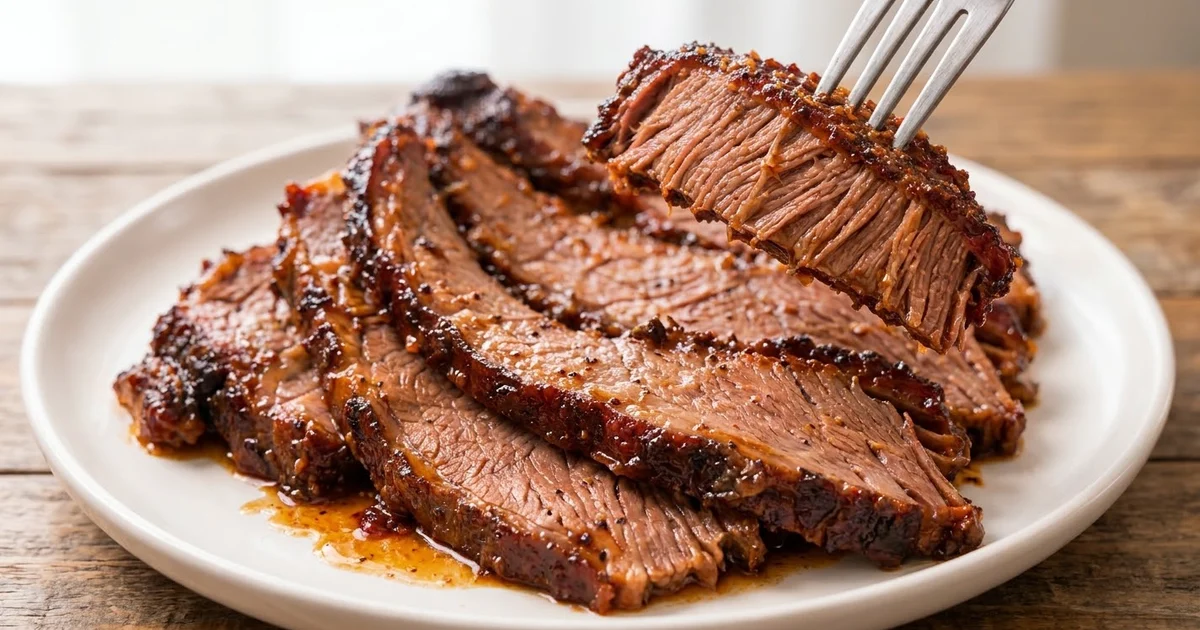
Slow cooker BBQ brisket gives you a smoky-tasting, deeply beefy brisket without a smoker, an oven, or a whole day of tending a fire. You season a whole brisket with salt and pepper, cover it with barbecue sauce, paprika and brown sugar, pour a little beef broth around it, and let the slow cooker do the rest. Hours later you lift the lid to tender meat sitting in its own savory juices.
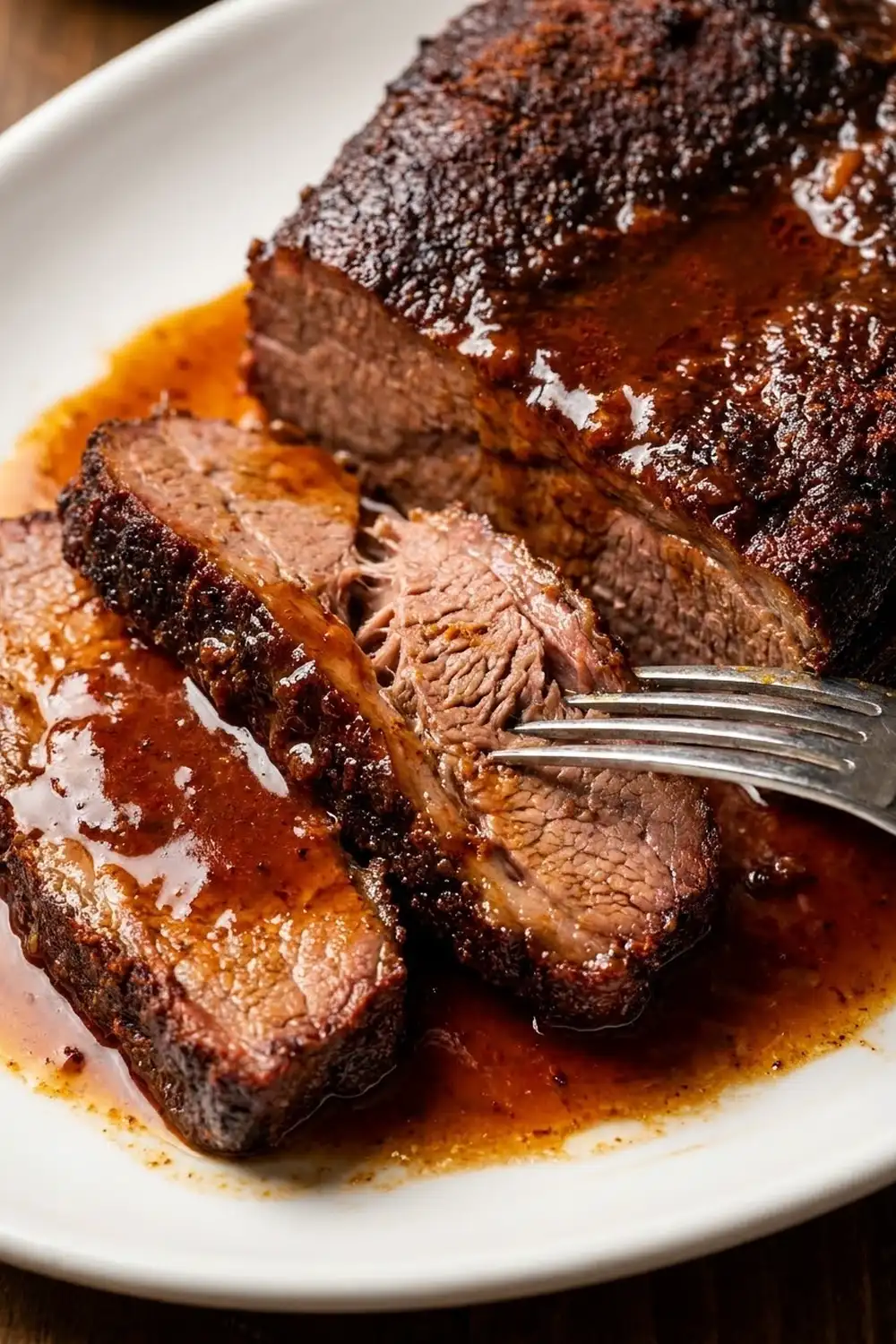
The flavor is the reward. The outside turns dark, sticky and glazed, sweet from the brown sugar and tangy from the sauce, with a gentle warmth from the paprika and black pepper. Inside, the meat is rosy-brown and juicy, with long fibers that come apart under a fork. Your kitchen will smell like a Sunday barbecue by mid-afternoon.
For home cooks, this is close to foolproof. Brisket is a tough, hard-working cut that needs long, gentle, moist heat to turn tender, and that’s exactly what a slow cooker does best. Hands-on time is about 15 minutes. You don’t need to sear, baste or check a thermometer every hour.
It’s a great fit for busy weekdays (start it before work), for game days, for holiday crowds, and for meal prep, because sliced brisket reheats beautifully. It’s also naturally gluten-free as long as your barbecue sauce and broth are labeled gluten-free.
Why This Recipe Works
Brisket is full of connective tissue (collagen), which makes it chewy when cooked quickly. Hold it at a low simmer for many hours and that collagen melts into gelatin. That’s what makes the slices feel juicy and silky instead of dry. The slow cooker keeps the temperature steady and gentle, and the lid traps moisture, so the meat braises instead of drying out.
The toppings go on in layers for a reason. Salt and pepper go straight onto the meat first, so they season the beef itself. Barbecue sauce comes next and acts like glue, holding the paprika and brown sugar in place. As the brisket cooks, the sugar melts into the sauce and the top turns into a dark, sticky, caramelized crust, much like the bark on smoked brisket.
The beef broth goes around the meat, not over it, so the topping doesn’t wash off. One cup is enough. The brisket releases plenty of its own juices, and too much liquid would boil the meat and water down the flavor. The broth and meat juices end up as a rich sauce for spooning over the slices.
Tips for Success
- Buy a little extra. Brisket shrinks by 30 to 40 percent as it cooks, so a 4 lb (1.8 kg) raw brisket gives about 2½ lb (1.1 kg) of cooked meat, enough for 8 good servings.
- Trim, but not too much. Leaving a ¼-inch (6 mm) fat cap keeps the meat juicy. Trim away thicker hard fat, which won’t melt.
- Mark the grain before cooking. Cut a small notch across the grain at one corner while the brisket is raw. Once it’s covered in glaze, the grain is much harder to see.
- For a stickier crust, move the cooked brisket to a foil-lined sheet pan, brush it with 2 tbsp of the cooking juices, and broil for 2 to 3 minutes. Watch it closely so the sugar doesn’t burn.
- Make it ahead. Cook the brisket a day early, chill it whole in its juices, then slice it cold. Cold brisket slices much more neatly. Reheat the slices in the juices.
- Thicken the juices if you like. Simmer 1½ cups (360 ml) of the skimmed juices in a saucepan for 8 to 10 minutes until they’re reduced by about a third.
- Know your cooker. Newer slow cookers often run hot. If yours does, check for tenderness at 7½ hours.
Variations
Smoky brisket. Swap the regular paprika for smoked paprika and add ½ tsp of liquid smoke to the broth. You get much more of the flavor of a pit-smoked brisket without changing anything else in the method.
Spicy brisket. Add ½ to 1 tsp of cayenne pepper or chipotle powder along with the paprika, and use a spicy barbecue sauce. The brown sugar balances the heat, so the glaze stays sweet with a slow burn.
Onion-braised brisket. Slice 2 medium yellow onions (about 300 g) and spread them in the bottom of the cooker before adding the brisket. They melt into the juices and make a sweeter, thicker sauce for serving.
Pulled brisket. Cook for the full 10 hours on LOW, then shred the meat with two forks right in the cooker instead of slicing it. Toss it with the juices and pile it onto toasted buns for sandwiches.
FAQ
Do I need to sear the brisket first?
No. The barbecue sauce, paprika and brown sugar build a dark, caramelized crust during the long cook, so searing isn’t needed for color or flavor. You can sear it in a hot skillet for 3 to 4 minutes per side if you want, but this recipe is designed to skip that step.
Can I cook it on HIGH instead of LOW?
Yes. Cook it on HIGH for 5 to 6 hours. The result is tender, but the meat can be slightly less juicy, because the faster cook gives the collagen less time to melt gently. LOW is best if your schedule allows it.
My brisket is tough. What went wrong?
Almost always, it needed more time. Tough brisket hasn’t finished breaking down its connective tissue, so cover it and keep cooking in 45- to 60-minute stretches until a fork slides in easily. If it’s tender in the cooker but chewy on the plate, it was probably sliced with the grain instead of across it.
Can I use a bigger or smaller brisket?
Yes, as long as it fits in your cooker with the lid closed. For a 3 lb (1.4 kg) brisket, cut the topping amounts by a quarter and check it at 7 hours. For a 5 lb (2.3 kg) brisket, add about 25 percent more seasoning and sauce, keep the broth at 1 cup (240 ml), and plan on the full 10 hours.
Can I put a frozen brisket in the slow cooker?
No. A frozen brisket spends too long in the temperature range where bacteria grow before the cooker heats it through. Thaw it in the refrigerator first, which takes about 24 hours for every 4 to 5 lb (1.8 to 2.3 kg).
Storage and Reheating
Let leftover brisket cool for no more than 2 hours. Store the slices in an airtight container with a few spoonfuls of the cooking juices poured over them. In the refrigerator, it keeps well for up to 4 days. The juices keep the meat from drying out and turn slightly jellied when cold, which is a good sign that the collagen melted properly.
To reheat, put the slices and their juices in a covered skillet over medium-low heat for 6 to 8 minutes, until they’re heated through. You can also cover a baking dish tightly with foil and warm it at 325°F (165°C) for 15 to 20 minutes. To microwave, cover the dish and heat at 50 percent power in 1-minute bursts, so the edges don’t toughen.
Brisket freezes very well. Pack the slices flat in freezer bags with the juices, squeeze out the air, and freeze for up to 3 months. Thaw them overnight in the refrigerator, then reheat as above.
Serving Suggestions
Creamy coleslaw is a classic partner. Its cool crunch and tang cut through the rich, sweet glaze. Mashed potatoes or buttery egg noodles are great for soaking up the juices, and a pan of cornbread brings a slightly sweet, crumbly contrast to the tender meat.
For something lighter, serve the brisket with roasted green beans or a simple green salad with a sharp vinaigrette. And if you have leftovers, soft buns with pickles and sliced onion turn them into excellent sandwiches the next day.
Final Notes
This slow cooker BBQ brisket takes a cut that seems intimidating and makes it easy, with no smoker, no babysitting, and only a handful of ingredients. Season it well, layer the toppings on top, keep the broth around the edges, and give it the time it needs. Then slice against the grain and spoon those juices over everything. Once you’ve made it, it will likely become your go-to for lazy Sundays, holidays, and anything in between.
Print
Slow Cooker BBQ Brisket Recipe
- Total Time: about 9 hours 30 minutes
- Yield: 8 1x
Description
A juicy, fork-tender brisket with a sticky barbecue glaze, made in the slow cooker with just 15 minutes of hands-on time.
Ingredients
- 1 beef brisket, flat cut, about 4 lb (1.8 kg), trimmed to a ¼-inch (6 mm) fat cap
- 2 tsp kosher salt (6 g)
- 1½ tsp coarsely ground black pepper (4 g)
- 1 cup (250 ml / about 280 g) barbecue sauce, plus extra for serving if you like
- 1 tbsp paprika (7 g)
- 3 tbsp packed light brown sugar (40 g)
- 1 cup (240 ml) low-sodium beef broth
Instructions
- Season and place the brisket. Pat the brisket dry with paper towels, then rub the kosher salt and black pepper all over it, pressing the seasoning into the meat. Lay it in the slow cooker fat side up. When it’s done right, you’ll see an even speckle of pepper over the whole surface, with no bare patches. Fat side up matters, because as the fat melts it bastes the meat. A common mistake is skipping the drying step. A wet surface lets the seasoning slide off and pool in the bottom.
- Drizzle on the barbecue sauce. Pour the barbecue sauce over the top of the brisket in long lines, then spread it with the back of a spoon so the whole top and upper sides are coated. It should look glossy and deep reddish-brown, with the pepper still showing through. Don’t press too hard while spreading, or you’ll wipe the salt and pepper off. Also avoid pouring a lot of sauce down the sides into the bottom of the cooker. You want most of it on top, where it will form the glaze.
- Sprinkle on the paprika and brown sugar. Pinch the paprika and sprinkle it evenly over the sauced brisket from about 8 inches (20 cm) above, so it lands in a fine, even layer. Then scatter the brown sugar over it, breaking up any clumps with your fingers. The top should look bright red with little golden crumbs of sugar, all stuck to the sauce. Avoid dumping everything in one spot. Clumps of sugar can scorch against the hot ceramic edges and turn bitter instead of melting into a glaze.
- Pour the broth around the meat. Slowly pour the beef broth into the gap between the brisket and the side of the insert, moving around the cooker. The liquid should come about ½ inch (1 cm) up the sides of the meat and pool in the bottom, leaving the topping dry and in place. Pouring broth straight over the top is the mistake to avoid here. It rinses off the paprika and sugar you just added and leaves you with a pale, washed-out crust.
- Cover and slow cook. Set the glass lid firmly in place and cook on LOW for 8 to 10 hours. HIGH for 5 to 6 hours works if you’re short on time, but LOW gives you more tender results. After a few hours the lid will fog up, and you’ll smell sweet, beefy barbecue aromas. Resist lifting the lid to check. Every peek lets out heat and steam and can add 15 to 20 minutes to the cooking time. Make sure the lid sits flat with no gaps.
- Check for tenderness. Near the end of cooking, lift the lid and check the brisket. It should have shrunk noticeably, the top should be a dark mahogany color with a sticky, caramelized crust, and it should be sitting in plenty of rich, bubbling juices. Push a fork into the thickest part and twist gently. It should go in with almost no resistance. If it still feels tight or springy, cover it and cook for another 45 to 60 minutes. Undercooked brisket is chewy, and more time is the only fix.
- Rest and slice against the grain. Carefully lift the brisket onto a cutting board with tongs and a large fork, supporting it from underneath. Let it rest for 15 minutes so the juices settle back into the meat. Look for the long lines of muscle fiber and slice across them into ¼-inch (6 mm) slices. Each slice should hold together but feel tender. The most common mistake is slicing with the grain, which gives you stringy, chewy strips even from perfectly cooked meat.
- Spoon on the juices and serve. Arrange the slices on a platter. Skim the fat off the cooking liquid with a spoon, then ladle a few spoonfuls of the juices over the meat. The slices should look glossy, and a fork should pull a slice apart with juices dripping off. Serve with extra barbecue sauce or the remaining juices on the side. Don’t skip this step. The juices hold a lot of flavor and keep the cut surfaces from drying out on the plate.
Notes
- Buy a little extra. Brisket shrinks by 30 to 40 percent as it cooks, so a 4 lb (1.8 kg) raw brisket gives about 2½ lb (1.1 kg) of cooked meat, enough for 8 good servings.
- Trim, but not too much. Leaving a ¼-inch (6 mm) fat cap keeps the meat juicy. Trim away thicker hard fat, which won’t melt.
- Mark the grain before cooking. Cut a small notch across the grain at one corner while the brisket is raw. Once it’s covered in glaze, the grain is much harder to see.
- For a stickier crust, move the cooked brisket to a foil-lined sheet pan, brush it with 2 tbsp of the cooking juices, and broil for 2 to 3 minutes. Watch it closely so the sugar doesn’t burn.
- Make it ahead. Cook the brisket a day early, chill it whole in its juices, then slice it cold. Cold brisket slices much more neatly. Reheat the slices in the juices.
- Thicken the juices if you like. Simmer 1½ cups (360 ml) of the skimmed juices in a saucepan for 8 to 10 minutes until they’re reduced by about a third.
- Know your cooker. Newer slow cookers often run hot. If yours does, check for tenderness at 7½ hours.
- Prep Time: 15 minutes
- Cook Time: 9 hours (8–10 hours on LOW)
- Category: Dinner