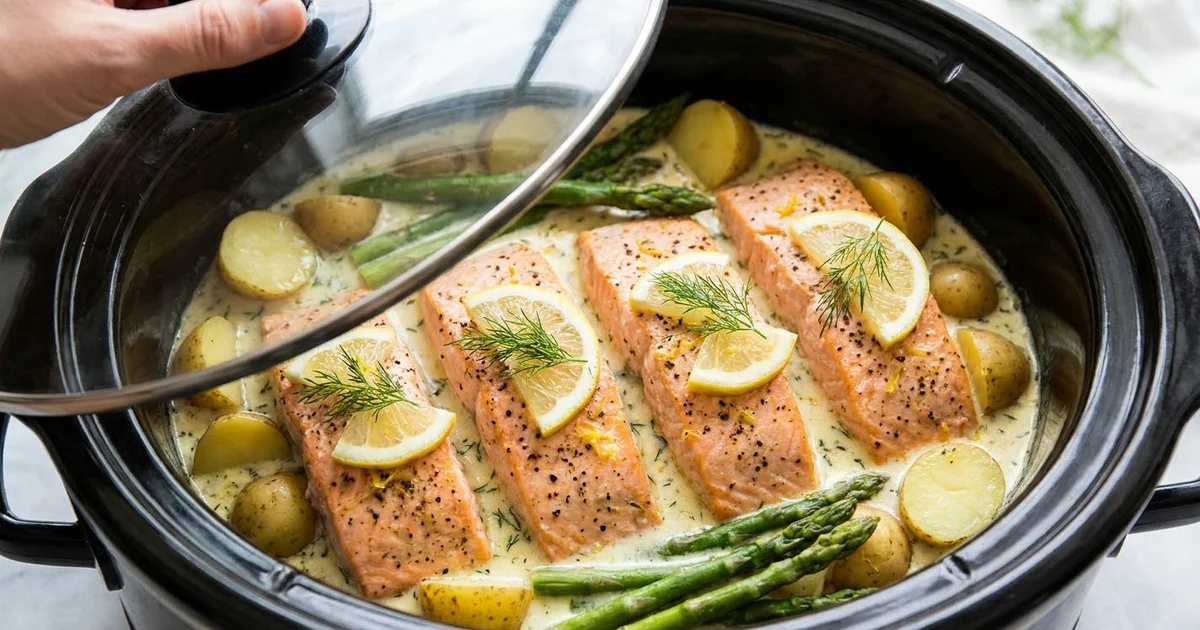
This slow cooker lemon dill salmon is a full dinner in one pot. Tender baby potatoes, bright asparagus and four thick salmon fillets cook together in a silky lemon-dill cream sauce. When you lift the lid, you get pink salmon, golden potatoes and green spears, all in a sauce speckled with fresh herbs.
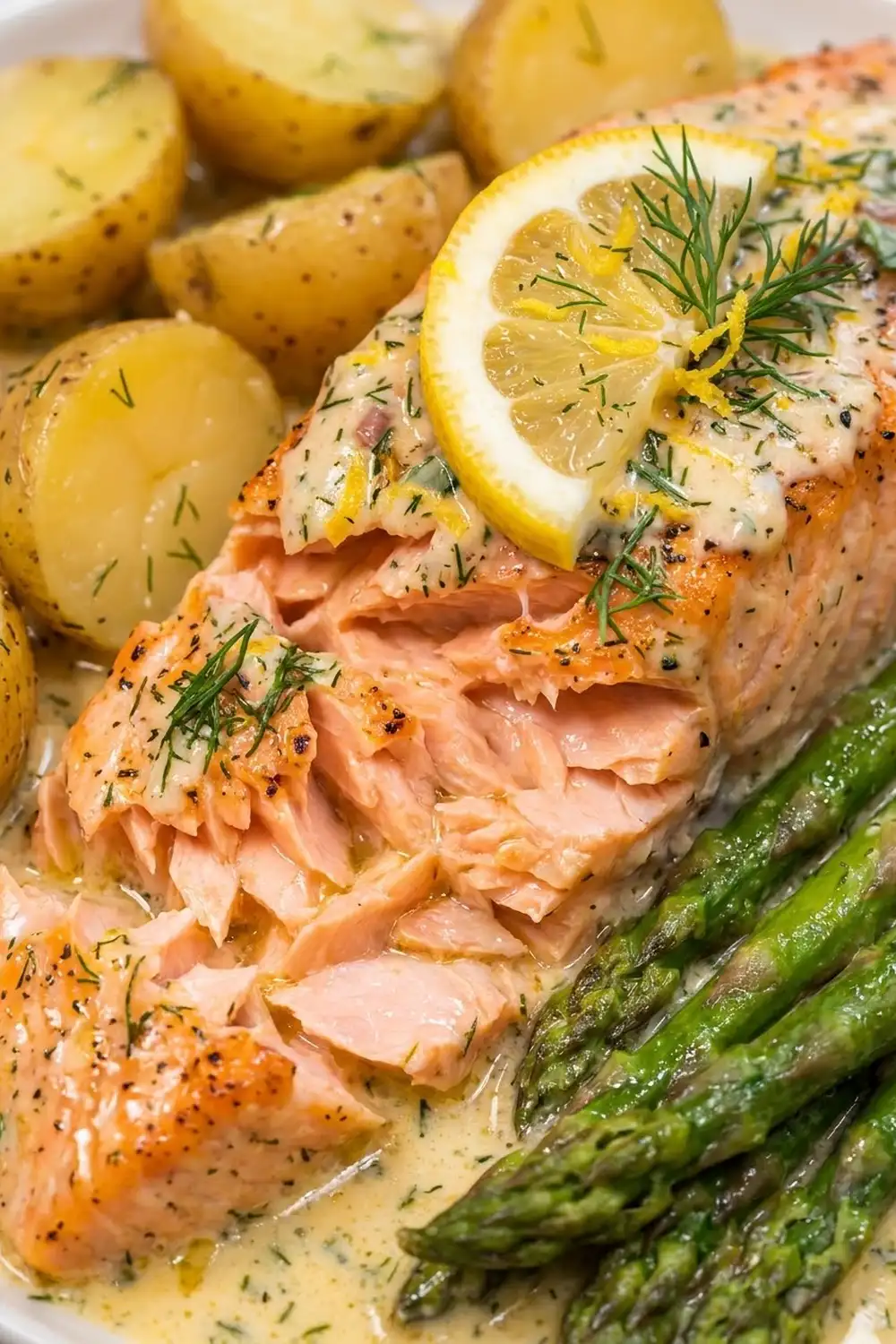
The flavor is fresh and comforting at the same time. Lemon zest and juice cut through the richness of the cream, and the dill adds a light, grassy note that suits salmon perfectly. The fish turns buttery and flakes apart with a fork. The potatoes soak up the garlicky broth until they’re creamy inside, and the asparagus stays tender with a little bite.
For home cooks, the best part is how hands-off it is. The potatoes cook on their own for a few hours, and the salmon only goes in for the last hour, so it doesn’t overcook. You don’t need to sear anything or juggle pans, and there’s only one pot to wash.
It’s a good fit for busy weeknights, relaxed Sunday dinners or a casual dinner with guests. It’s naturally gluten-free, and it’s an easy way to get more fish into your week without any fuss.
Why This Recipe Works
Timing is the most important thing here. Potatoes need hours in a slow cooker, but salmon needs less than one. If you put everything in at the start, you get either hard potatoes or dry, chalky fish. Cooking the potatoes first in broth, butter and garlic gives them a head start. When the salmon goes in, the pot is already hot and steamy, so the fish cooks gently and evenly.
The cream goes in late too. Dairy that simmers for hours in a slow cooker can split and turn grainy. Whisking the cream with a little cornstarch and adding it near the end keeps the sauce smooth and helps it thicken just enough to coat the potatoes. The lemon juice is mixed into the cream with the starch, so it brightens the sauce without curdling it.
Finally, the lemon slices and dill sprigs on top of each fillet do more than look nice. As the fish cooks, they release their aromatic oils straight into the salmon, so every bite tastes of lemon and herbs.
Tips for Success
- Keep the potatoes the same size. Halve baby potatoes about 1½ inches (4 cm) across, and quarter any larger ones so everything is tender at the same time.
- Bring the salmon to cool room temperature. Leave the fillets out for 15 minutes before adding them so the center doesn’t stay cold.
- Thick asparagus works better. Medium or thick spears hold up in the moist heat. Pencil-thin spears can go limp, so add those in the last 20 minutes.
- Wait until the end to add more salt. Broth can be salty, so taste the sauce after cooking and adjust then.
- Thicken the sauce if needed. If it’s thin, take out the salmon, stir in 1 teaspoon cornstarch mixed with 1 tablespoon water, and cook uncovered on HIGH for 10 minutes.
- Prep ahead. You can halve the potatoes, mince the garlic and trim the asparagus the night before. Keep the potatoes covered in water in the fridge.
- Know your slow cooker. Newer models often run hot, so check the salmon at 40 minutes the first time you make this.
Variations
Garlic Parmesan: Whisk ⅓ cup (30 g) finely grated Parmesan into the cream sauce. It melts into a savory, slightly nutty sauce that’s richer than the original.
Dairy-free: Use full-fat canned coconut milk instead of the heavy cream and olive oil instead of butter. The sauce gets a subtle sweetness that goes surprisingly well with lemon.
Green beans instead of asparagus: Trimmed green beans work in the same amount and timing, and they’re often cheaper outside spring.
Spicy lemon: Add ¼ tsp (about 0.5 g) red pepper flakes to the potatoes and a pinch of smoked paprika (about ⅛ tsp) to the salmon tops. This adds gentle heat without hiding the dill.
FAQ
Can I use frozen salmon?
Yes, but thaw it first in the fridge overnight, or in cold water for about an hour. Frozen fillets release a lot of water, which thins the sauce, and they cook unevenly. Pat thawed fillets very dry before seasoning.
Can I leave the skin on?
You can, but the skin won’t crisp in a slow cooker and stays soft. If you leave it on, place the fillets skin-side down and slide the flesh off the skin when serving. Skinless fillets are easier to eat straight from the sauce.
Why did my cream sauce curdle?
Usually the cream was added too early or the sauce boiled too hard. Adding the cream with cornstarch near the end, as written, prevents this. Full-fat heavy cream is also much more stable than milk or light cream.
Can I cook the salmon on LOW?
Yes. After adding the salmon, cook on LOW for 1 hour 15 minutes to 1 hour 45 minutes. It cooks more gently, but check it with a thermometer, since slow cookers vary a lot.
Can I double the recipe?
Only if you have a 7- or 8-quart slow cooker and the fillets can still lie in a single layer. Add about 30 minutes to the potato cooking time. The salmon timing stays roughly the same.
Storage and Reheating
Put leftovers in an airtight container within 2 hours of cooking and refrigerate for up to 2 days. Salmon is best eaten soon, and the asparagus will soften as it sits.
Reheat gently so the salmon doesn’t dry out. Warm portions in a covered skillet over low heat with 1–2 tablespoons of broth for 6–8 minutes. You can also microwave them covered at 50% power in 1-minute bursts. Leftover salmon is also nice cold, flaked over a green salad.
Freezing isn’t recommended. Cream sauces tend to separate when thawed, and the potatoes and asparagus turn watery and grainy. If you need to freeze it, freeze only the salmon and sauce for up to 1 month, thaw overnight in the fridge, and reheat slowly.
Serving Suggestions
A crisp green salad with a simple vinaigrette is a good match, because the acidity balances the creamy sauce. Warm crusty bread or dinner rolls are great for soaking up the extra lemon dill sauce.
For a heartier meal, serve it with steamed rice to stretch the sauce further. A side of cucumber slices tossed with vinegar and a little dill adds a cool crunch and echoes the herbs in the main dish.
Final Notes
This slow cooker lemon dill salmon shows that slow cooking can be bright and fresh, not just for heavy stews. Once you’ve got the timing down (potatoes first, salmon last), you can make it with almost any vegetables and herbs you have in the fridge. Keep a thermometer nearby, don’t keep peeking under the lid, and enjoy a dinner that looks impressive with very little effort.
Print
Slow Cooker Lemon Dill Salmon with Potatoes and Asparagus Recipe
- Total Time: 3 hours 50 minutes
- Yield: 4 1x
Description
Tender salmon, baby potatoes and asparagus cooked together in a silky lemon dill cream sauce. It’s a hands-off slow cooker dinner with only one pot to wash.
Ingredients
- 1 ½ lb (680 g) baby yellow potatoes, halved
- 1 cup (240 ml) low-sodium chicken or vegetable broth
- 2 tbsp (28 g) unsalted butter, melted
- 3 cloves garlic, minced (about 1 tbsp)
- ¾ tsp kosher salt
- ¼ tsp black pepper
- ¾ cup (180 ml) heavy cream
- 1 tbsp (8 g) cornstarch
- Zest of 1 lemon (about 1 tsp)
- 2 tbsp (30 ml) fresh lemon juice
- 2 tbsp fresh dill, chopped (or 2 tsp dried dill)
- 4 salmon fillets, about 6 oz (170 g) each, skin removed
- ½ tsp kosher salt
- ½ tsp coarse black pepper
- 1 lb (450 g) asparagus, woody ends trimmed, cut into 4-inch (10 cm) lengths
- 1 lemon, thinly sliced into rounds
- 4–6 small fresh dill sprigs, for topping
Instructions
- Build the potato base. Halve the baby potatoes and put them in the slow cooker in an even layer. Pour in the broth and melted butter, then add the garlic, ¾ teaspoon salt and ¼ teaspoon pepper. Stir to coat. Most of the potatoes should sit partly in the liquid, and the garlic should smell sharp and fresh. Cut the potatoes into similar sizes. A common mistake is leaving a few large ones whole, and those will still be firm when the rest are tender.
- Cook the potatoes. Put the lid on and cook on HIGH for 2½ to 3 hours, or on LOW for 4½ to 5 hours, until a paring knife slides into a potato with almost no resistance. The broth should be gently bubbling around the edges, and the kitchen should smell buttery and garlicky. Don’t keep lifting the lid to check. Each peek lets out heat and steam, which can add 15 to 20 minutes to the cooking time.
- Stir in the lemon dill cream. In a small bowl, whisk the cream, cornstarch, lemon zest, lemon juice and chopped dill until smooth and free of lumps. Pour it into the slow cooker and stir gently so the potatoes are coated. The liquid should turn a pale, creamy yellow with green flecks of dill. Always mix the cornstarch with the cold cream first. If you sprinkle it straight into the hot broth, it forms clumps that won’t dissolve.
- Add the salmon and asparagus. Pat the salmon dry and season the tops with ½ teaspoon salt and ½ teaspoon coarse pepper. Nestle the fillets into the sauce in a single layer, pushing the potatoes aside so the fish sits partly in the liquid. Tuck the asparagus pieces around and between the fillets. The salmon should be about halfway in the sauce, not fully underwater. Fillets stacked on top of each other will cook unevenly.
- Top with lemon and dill, then cook. Place a lemon slice on each fillet, sprinkle over any leftover zest and lay small dill sprigs on top. Cover and cook on HIGH for 45 to 60 minutes. The salmon is ready when it turns opaque pink, flakes easily at its thickest point and reads 135–140°F (57–60°C). Start checking at 45 minutes. Salmon goes from silky to dry fast, and thinner fillets finish first.
- Lift the lid and serve. Turn off the slow cooker, lift the lid and let the dish rest for 5 minutes. The sauce will thicken slightly and the salmon will finish at about 145°F (63°C). The asparagus should be bright green and tender-crisp, and the sauce should coat a spoon. Spoon the potatoes, asparagus and plenty of sauce onto plates, then lift each fillet out whole with a wide spatula. Don’t use tongs, because they’ll break the delicate fish.
Notes
- Keep the potatoes the same size. Halve baby potatoes about 1½ inches (4 cm) across, and quarter any larger ones so everything is tender at the same time.
- Bring the salmon to cool room temperature. Leave the fillets out for 15 minutes before adding them so the center doesn’t stay cold.
- Thick asparagus works better. Medium or thick spears hold up in the moist heat. Pencil-thin spears can go limp, so add those in the last 20 minutes.
- Wait until the end to add more salt. Broth can be salty, so taste the sauce after cooking and adjust then.
- Thicken the sauce if needed. If it’s thin, take out the salmon, stir in 1 teaspoon cornstarch mixed with 1 tablespoon water, and cook uncovered on HIGH for 10 minutes.
- Prep ahead. You can halve the potatoes, mince the garlic and trim the asparagus the night before. Keep the potatoes covered in water in the fridge.
- Know your slow cooker. Newer models often run hot, so check the salmon at 40 minutes the first time you make this.
- Prep Time: 20 minutes
- Cook Time: 3 hours 30 minutes (on HIGH)
- Category: Dinner