
This is a one-pot dinner. Tender baby gold potatoes slowly simmer in a garlicky cream sauce, fresh spinach wilts right into it, and golden seared salmon fillets finish cooking gently on top. The slow cooker does most of the work, and you lift the lid on a complete meal: protein, starch, and greens all in one pot.
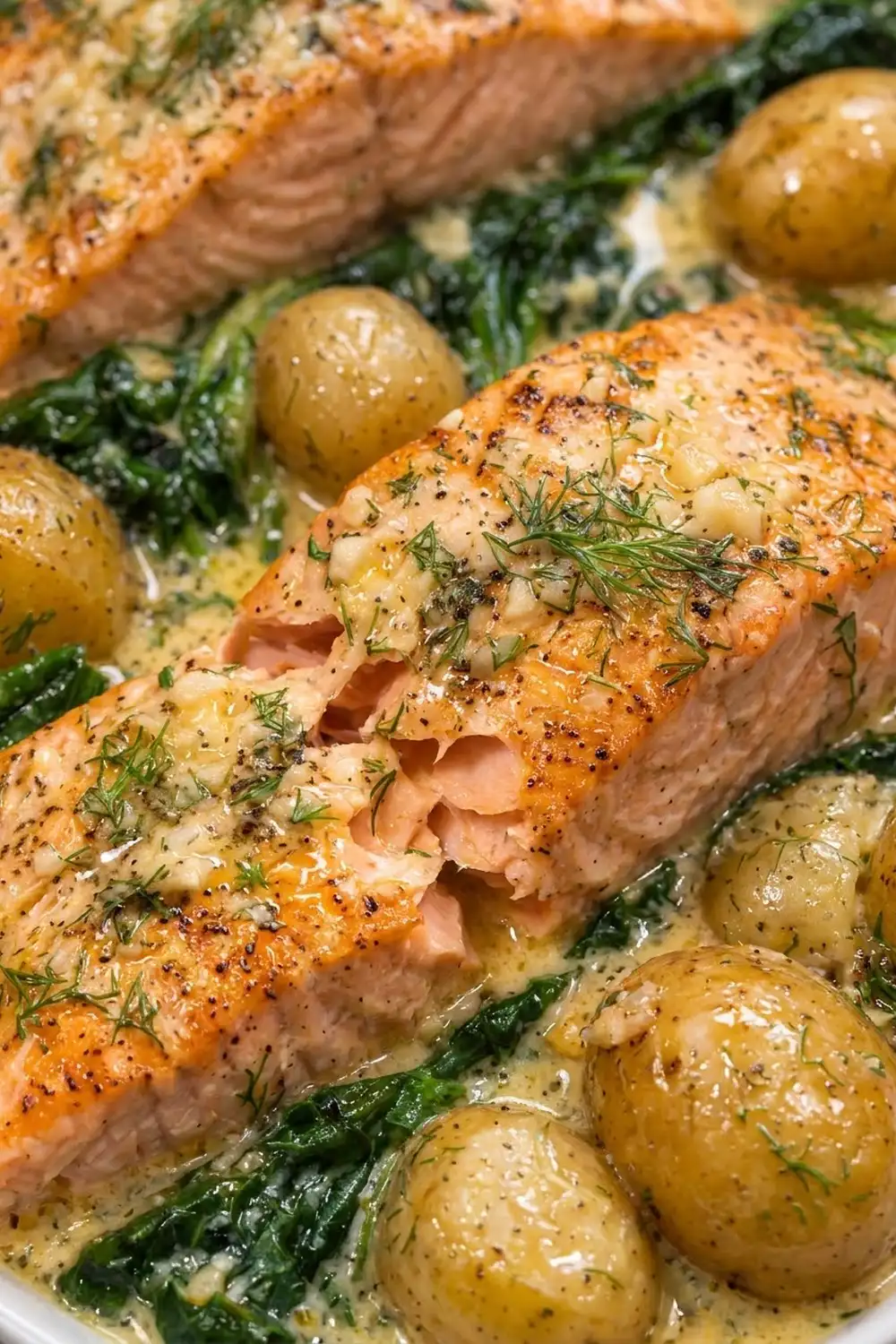
The flavor is rich but still bright. When you lift the lid, you smell warm garlic and fresh dill. The salmon flakes into big, juicy pieces with a lightly crisp, peppery edge. The potatoes turn buttery inside and soak up the sauce. The spinach adds an earthy note that keeps the cream from feeling too heavy.
For home cooks, this recipe is very forgiving. Salmon can be tricky in a skillet, where a minute too long dries it out. In the low, moist heat of a slow cooker, it stays tender. The potatoes cook almost hands-off, so you can run errands or help with homework while dinner takes care of itself.
It works for busy weeknights, a cozy Sunday supper, or a casual dinner for guests. It’s naturally gluten-free and fairly high in protein. It’s also easy to scale for a bigger slow cooker when you’re feeding a crowd.
Why This Recipe Works
The potatoes and the salmon go in at different times. Potatoes need hours to soften, and salmon needs only about 30 minutes. If you add them together, you get either hard potatoes or chalky fish. Here the potatoes cook first in broth and garlic. The salmon goes in near the end, so both come out right.
A quick sear adds flavor the slow cooker can’t. A slow cooker never gets hot enough to brown food. Searing the salmon for 2 minutes in a hot skillet gives it the golden, peppery crust you see in the photo. It also firms up the surface, which helps the fillets hold together in the sauce.
The cream goes in late, with a little cornstarch. Heavy cream simmered for hours can separate and turn greasy. Adding it in the last stage keeps the sauce smooth. A small cornstarch slurry thickens it just enough to coat the potatoes without turning gluey. The potatoes also release some starch, which adds body.
Tips for Success
- Choose potatoes of the same size so they all finish at the same time. Halve any that are much bigger than the rest.
- Dry the salmon well before searing. Surface moisture causes steaming, not browning, and you’ll lose that golden crust.
- Use a thermometer. Thin fillets may be done in 20 minutes, while thick ones can take 40.
- Don’t swap in milk for the cream. Low-fat dairy is much more likely to curdle under long, gentle heat.
- If the sauce is too thick, add broth 2 tbsp (30 ml) at a time. Potatoes keep absorbing liquid as they sit.
- To prep ahead, mince the garlic and wash the potatoes the night before, then keep them refrigerated in separate containers.
- No slow cooker? Simmer the potatoes covered in a Dutch oven at 300°F (150°C) for about 1 hour, then follow the same steps.
- Taste before serving. Add a pinch of salt (about ⅛ tsp) if the sauce tastes flat.
Variations
Lemon salmon: Stir the zest of 1 lemon into the cream in Step 2. Squeeze 1 tbsp (15 ml) of lemon juice over the salmon just before serving. Add it at the end so the acid doesn’t curdle the cream.
Parmesan cream sauce: Stir ½ cup (50 g) finely grated Parmesan into the sauce just before adding the spinach. The sauce will be thicker and saltier, so leave out the second ½ tsp of salt.
Sun-dried tomato version: Add ⅓ cup (55 g) chopped oil-packed sun-dried tomatoes with the cream. They add sweet-tart flavor and red color against the green spinach.
Dairy-free: Use 1 cup (240 ml) full-fat canned coconut milk instead of cream and olive oil instead of butter. The sauce will taste slightly sweet, which goes nicely with the dill.
FAQ
Can I put raw salmon in without searing it?
Yes, the salmon will still cook through and stay tender. You’ll miss the golden crust and some savory depth, and the fillets will look pale. If you skip searing, sprinkle the tops with paprika for color.
Can I use frozen salmon straight from the freezer?
It’s not recommended. Frozen fillets release water that thins the sauce, and they cook unevenly, with the edges overdone before the center is ready. Thaw them overnight in the fridge, or seal them in a bag and submerge it in cold water for about 45 minutes.
Why did my cream sauce separate?
Usually the cream was added too early or cooked too long, or a lower-fat dairy was used. Add heavy cream only in the final hour, as written. If it does separate, stir in 2 tbsp (30 ml) of warm cream to help bring it back together.
Can I cook the whole thing on LOW?
Yes. Cook the potatoes on LOW for 5 to 6 hours. Then switch to HIGH for the sauce and salmon steps, since LOW can take over an hour to finish the fish. That longer, uneven cooking makes overcooking more likely.
Can I use skin-on salmon?
You can, but the skin turns soft and rubbery in the moist slow cooker. If you prefer skin-on, sear the skin side down until crisp, then peel it off before serving or place the fillets skin side up.
Storage and Reheating
Let leftovers cool for no more than 1 hour. Then move them to an airtight container and refrigerate for up to 2 days. Salmon is best eaten soon, and the potatoes keep absorbing sauce, so leftovers will be thicker the next day.
To reheat, put a portion in a covered dish and microwave at 50% power for 1 to 2 minutes, stirring the sauce halfway through. Or warm it gently in a covered skillet over low heat with 2 to 3 tbsp (30 to 45 ml) of broth for 5 to 7 minutes. High heat will dry out the salmon and can split the sauce.
This dish doesn’t freeze well. Cream sauces turn grainy and potatoes turn mealy after thawing. If you must freeze it, store it for up to 1 month, thaw overnight in the fridge, and reheat slowly, whisking the sauce to smooth it out.
Serving Suggestions
Serve with warm crusty bread for soaking up the extra garlic cream. Its crisp crust also contrasts nicely with the soft potatoes. A simple green salad with a sharp vinaigrette cuts through the richness and makes the meal feel lighter.
For more vegetables, try roasted green beans or steamed asparagus. Their fresh snap works well with the dill. For a heartier spread, serve a scoop of plain rice to catch every bit of sauce.
Final Notes
Lifting the lid on this pot is very satisfying: golden salmon, tender potatoes, and dark green spinach in a garlicky cream sauce, all from one pot with very little effort. The keys are adding the salmon late, searing it first for color, and checking it with a thermometer instead of guessing. Once you’ve made it the plain way, try a lemony, cheesy, or dairy-free version.
Print
Slow Cooker Creamy Garlic Dill Salmon with Potatoes and Spinach Recipe
- Total Time: 3 hours 45 minutes
- Yield: 4 1x
Description
Golden seared salmon, tender baby potatoes and wilted spinach in a garlic-dill cream sauce, all cooked hands-off in one slow cooker.
Ingredients
- 1 ½ lb (680 g) baby gold potatoes, left whole (about 1 ½ inches across)
- 1 cup (240 ml) low-sodium chicken or vegetable broth
- 6 cloves garlic, minced (about 2 tbsp / 18 g)
- 1 tsp (6 g) kosher salt, divided
- ½ tsp (1 g) black pepper
- 2 tbsp (28 g) unsalted butter
- 1 cup (240 ml) heavy cream
- 1 tbsp (8 g) cornstarch mixed with 2 tbsp (30 ml) cold water
- 2 tbsp (6 g) chopped fresh dill
- 4 skin-off salmon fillets, about 6 oz (170 g) each and 1 inch thick
- 1 tbsp (15 ml) olive oil
- ½ tsp (3 g) kosher salt
- ½ tsp (1 g) black pepper
- ½ tsp (1 g) garlic powder
- 4 packed cups (120 g) fresh baby spinach
- 1 tbsp (3 g) fresh dill fronds, for garnish
Instructions
- Start the potatoes. Rinse the potatoes and add them whole to the slow cooker. Add the broth, minced garlic, ½ tsp salt, pepper, and butter. Stir so the garlic is evenly spread and not clumped in one spot. Cover and cook on HIGH for 3 hours (or LOW for 5 to 6 hours). They’re ready when a paring knife slides into the largest potato with almost no resistance. Don’t cut the potatoes in half to save time. Halved potatoes break down and turn the sauce cloudy and mushy.
- Make the cream sauce. Whisk the cornstarch and cold water together until there are no lumps. Uncover the cooker and pour in the heavy cream, the slurry, the chopped dill, and the remaining ½ tsp salt. Stir gently around the potatoes. Cover and cook on HIGH for 15 minutes, until the sauce looks pale gold, slightly thickened, and gently bubbling at the edges. Always mix cornstarch with cold liquid first. Added straight to hot liquid, it forms stubborn lumps.
- Sear the salmon. While the sauce thickens, pat the fillets very dry with paper towels. Season both sides with salt, pepper, and garlic powder. Heat the olive oil in a skillet over medium-high heat until it shimmers. Lay the fillets in presentation-side down and don’t move them for 2 minutes, until a deep golden crust forms and they release easily. Flip and sear 30 seconds more, then take them off the heat. Don’t try to cook them through here. This step is only for color and flavor.
- Wilt the spinach. Scatter the baby spinach over the hot sauce and press it down gently with a spoon so it touches the liquid. Within 2 to 3 minutes it will collapse into dark, glossy ribbons. Fold it lightly so it weaves between the potatoes, as in the photo. If the spinach looks like a lot, that’s normal. Four cups shrink to less than one. Just don’t pile it into a single dense mat where the salmon will sit.
- Nestle in the salmon and cover. Tuck the seared fillets into the sauce, browned side up, leaving space between them. Spoon a little sauce along the sides but keep the golden tops exposed. Cover with the lid and cook on HIGH for 25 to 35 minutes. Lifting the lid lets out heat and adds about 15 minutes of cooking time, so check only near the end. The salmon is done when it flakes easily with a fork and reads 130 to 135°F (54 to 57°C) in the thickest part.
- Garnish and serve. Lift the lid, scatter the fresh dill fronds over the salmon, and add a final crack of black pepper. Switch the cooker to WARM or turn it off. Serve right away, spooning potatoes, spinach, and plenty of sauce under each fillet. Don’t leave the salmon on WARM for more than 20 minutes. It keeps cooking and will start to turn firm and dry.
Notes
- Choose potatoes of the same size so they all finish at the same time. Halve any that are much bigger than the rest.
- Dry the salmon well before searing. Surface moisture causes steaming, not browning, and you’ll lose that golden crust.
- Use a thermometer. Thin fillets may be done in 20 minutes, while thick ones can take 40.
- Don’t swap in milk for the cream. Low-fat dairy is much more likely to curdle under long, gentle heat.
- If the sauce is too thick, add broth 2 tbsp (30 ml) at a time. Potatoes keep absorbing liquid as they sit.
- To prep ahead, mince the garlic and wash the potatoes the night before, then keep them refrigerated in separate containers.
- No slow cooker? Simmer the potatoes covered in a Dutch oven at 300°F (150°C) for about 1 hour, then follow the same steps.
- Taste before serving. Add a pinch of salt (about ⅛ tsp) if the sauce tastes flat.
- Prep Time: 15 minutes
- Cook Time: 3 hours 30 minutes (on HIGH)
- Category: Dinner