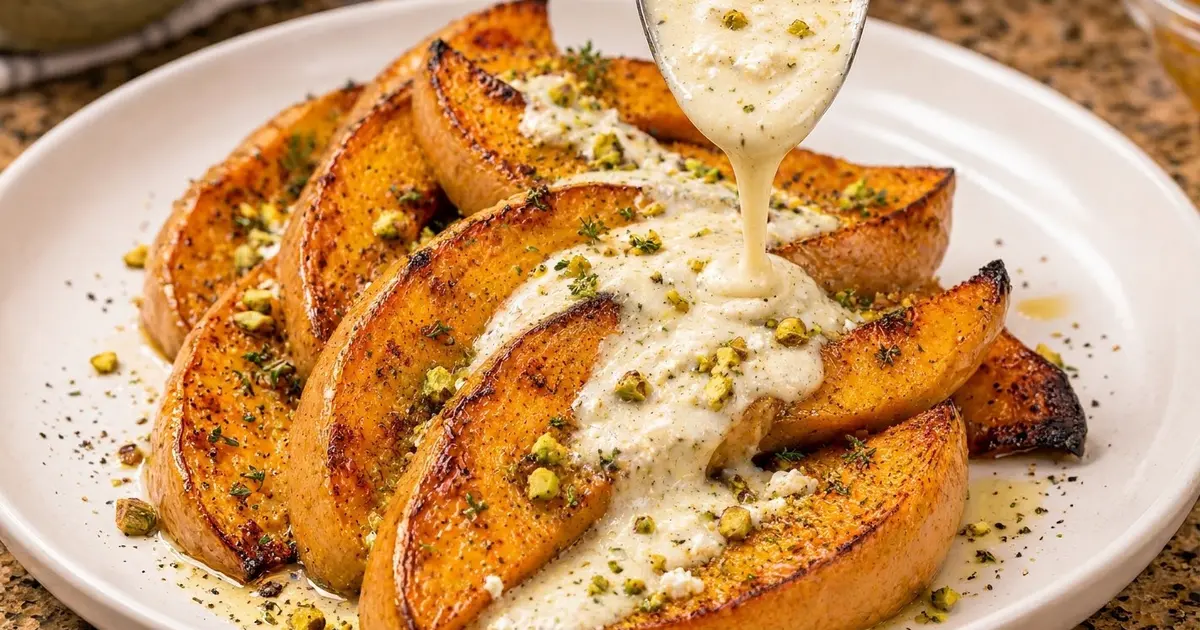
These roasted butternut squash wedges with creamy feta sauce make a simple vegetable look like you made a real effort. Thick wedges of squash roast in a hot oven until the edges turn deep golden and lightly charred. Then they get a generous drizzle of tangy whipped feta sauce, a scatter of chopped pistachios and some fresh thyme.
The contrast is what makes this dish. The squash goes sweet, nutty and almost jammy inside, with crisp, caramelized edges that taste a little like toffee. The feta sauce is cool, salty and bright with lemon. The pistachios add crunch, and the thyme brings an earthy, piney smell that ties it together.
It’s very easy for a home cook. There’s no sauce to simmer and no special technique, just good roasting and a quick blend. Most of the time is hands-off while the oven works, so you can make a main dish or set the table in the meantime.
It works on a weeknight next to roast chicken, as a vegetarian main with grains, or on a holiday table where it looks as good as it tastes. It’s naturally gluten-free. You can also roast the squash ahead for meal prep and add the sauce just before serving.
Why This Recipe Works
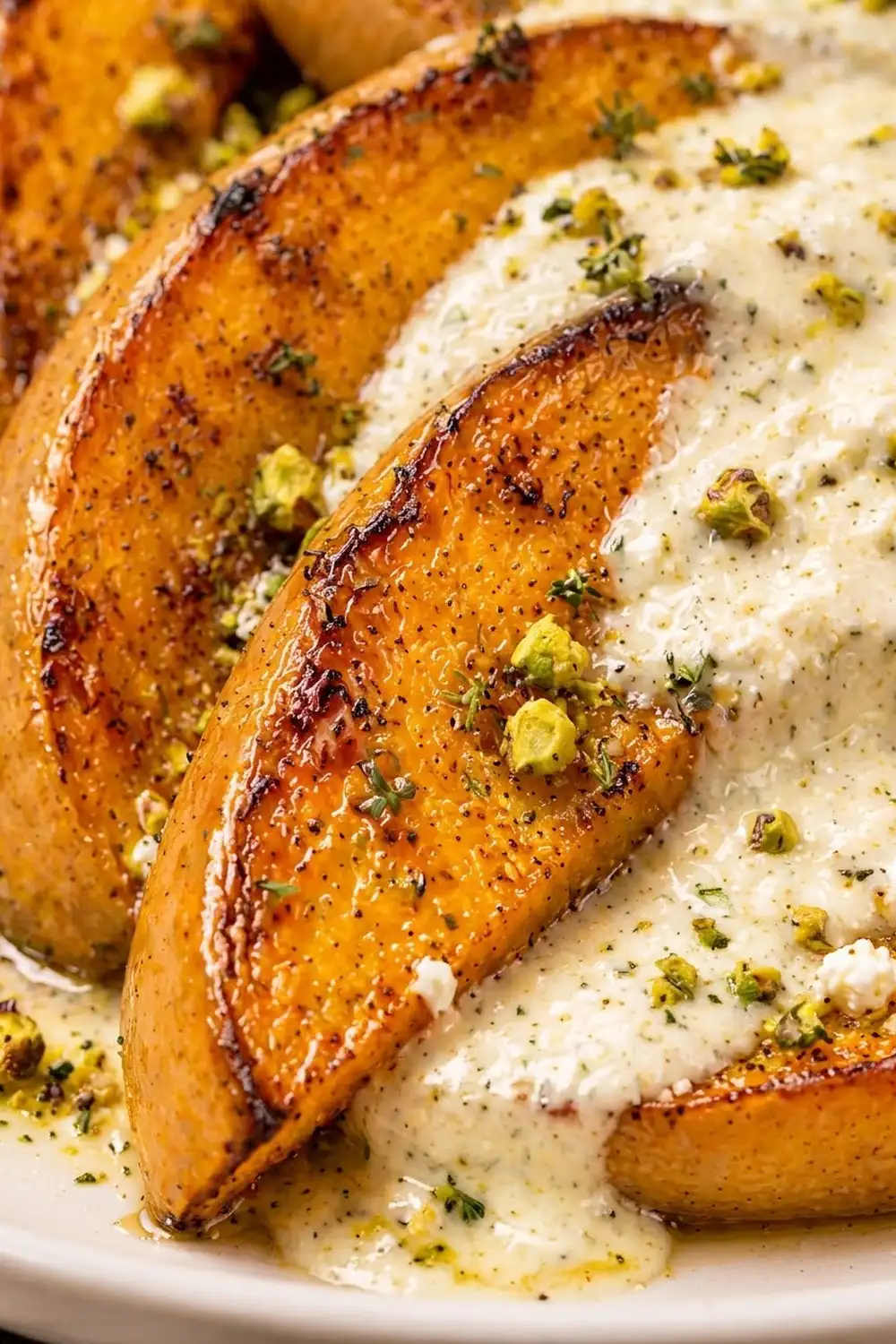
High heat gives you caramelization, not steam. At 425°F (220°C), the natural sugars on the cut faces of the squash brown quickly while the inside turns tender. At a lower temperature the squash softens before it colors, so it ends up pale and mushy. Turning the wedges halfway through means both cut sides touch the hot pan and both get those dark, glossy edges you see in the photo.
Wedges have the right shape. Long wedges about 1 inch (2.5 cm) thick at their widest point have plenty of surface for browning but are still thick enough to stay creamy inside. Cubes have more edges, but they dry out faster and don’t look as dramatic on a platter.
The sauce balances the sweetness. Roasted squash is rich and sweet, so it needs salt and acid. Blending feta with Greek yogurt makes a sauce thick enough to cling to the wedges but loose enough to pour from a spoon. Lemon juice brightens it, and leaving a few small crumbles of feta unblended gives it texture. The toasted pistachios add crunch and a buttery flavor that goes well with both the squash and the cheese.
Tips for Success
- Dry the squash before oiling it. If you rinsed it, pat it dry with a towel, since surface water works against browning.
- Preheat the pan if you like. Putting the empty baking sheet in the oven for 5 minutes beforehand gives the wedges a head start on searing.
- Microwave a hard squash first. If it’s very hard to cut, microwave it whole for 2 to 3 minutes to soften the skin and flesh a little.
- Make the sauce ahead. The feta sauce keeps for up to 3 days in the fridge. Stir in a splash of milk before serving, since it thickens as it sits.
- Taste before adding more salt. Feta can be very salty, so taste the sauce before seasoning it further.
- Use the oven’s convection setting if you have it. Roast at 400°F (205°C) on convection and check 5 minutes early.
- Serve the sauce on the side for a crowd. Some guests will want more sauce and some less, and the wedges stay crispier this way.
Variations
Honey-glazed wedges. Brush the wedges with 1 tablespoon of warmed honey for the last 5 minutes of roasting. The honey adds extra shine and caramelization, which works well against the salty feta.
Spiced squash. Toss the raw wedges with 1 teaspoon smoked paprika and ½ teaspoon ground cumin along with the salt and pepper. This gives the dish a smoky, warmer flavor that suits cold-weather dinners.
Herby green sauce. Blend a small handful of fresh dill or parsley into the feta sauce. It turns pale green and tastes fresher, which is nice in spring.
Sweet potato swap. Use 2 large sweet potatoes cut into wedges with the skin on, and roast them for about the same time. They have a slightly denser texture, and the skin adds a little chew.
FAQ
Do I have to peel the butternut squash?
Butternut skin is edible once roasted, but on thick wedges it can stay chewy. Peeling gives you the soft, glossy wedges shown here. If you’d like to skip peeling, cut thinner wedges about ¾ inch (2 cm) thick so the skin gets more tender.
Can I use goat cheese instead of feta?
Yes. Soft goat cheese makes a tangier, even creamier sauce. Use the same weight and start with only 1 tablespoon of milk, because goat cheese blends thinner than feta.
Why didn’t my squash brown?
Usually the pan was crowded, the oven wasn’t fully preheated, or the wedges were wet. Spread them out with space between each one, and use an oven thermometer to check that it really reaches 425°F. Dark pans brown faster than shiny ones too.
Can I make this dairy-free?
Blend ¾ cup (100 g) soaked raw cashews with 3 tablespoons water, the lemon juice, garlic and ½ teaspoon salt for a similar creamy drizzle. You’ll lose the feta’s tang, so add an extra teaspoon of lemon juice.
Is this a side or a main?
It’s a side for 4, or a light vegetarian main for 2. To make it more filling as a main, serve it over quinoa or farro, or add a can of drained, roasted chickpeas to the pan for the last 15 minutes.
Storage and Reheating
Store leftover squash and sauce in separate airtight containers in the fridge. The squash keeps for up to 4 days and the feta sauce for up to 3 days. Store the pistachios at room temperature so they stay crunchy.
To reheat, spread the wedges on a baking sheet and warm them in a 400°F (205°C) oven for 8 to 10 minutes, which brings back some of the crisp edges. The microwave works in a pinch, but the squash will be softer. Let the sauce sit at room temperature for 10 minutes and stir it before drizzling. Don’t heat the sauce, or it will separate.
Roasted squash freezes reasonably well for up to 3 months. Freeze the wedges in a single layer, then move them to a freezer bag. Thaw them overnight in the fridge and reheat them in the oven, but expect a softer texture that works better mashed or in a grain bowl. Don’t freeze the feta sauce, because yogurt and feta turn grainy once thawed.
Serving Suggestions
Serve these wedges with simple roast chicken or pan-seared pork chops. The tangy sauce works as a sauce for the meat as well. For a vegetarian meal, put them over warm farro or lentils with a lemony arugula salad. The greens add a peppery freshness, and the grains soak up any extra sauce.
On a holiday table, they go well with roast turkey and green beans and add color next to the browns and greens. They’re also good with crusty bread for wiping up the sauce left on the plate.
Final Notes
This is the kind of recipe that makes people take a second look at a vegetable they thought they knew. Peel and cut evenly, give the wedges plenty of space and heat, and let them get darker than you’d expect. The feta sauce and pistachios take only a few minutes and turn plain roasted squash into a dish you could serve to guests. Once you’ve made it, you’ll probably keep the sauce on hand for other roasted vegetables too.
Print
Roasted Butternut Squash Wedges with Creamy Feta Sauce Recipe
- Total Time: 50 minutes
- Yield: 4 1x
Description
Caramelized butternut squash wedges with a cool, tangy feta sauce, crunchy pistachios and fresh thyme. It’s an easy side that looks like you made a real effort.
Ingredients
- 1 large butternut squash, about 2½ lb (1.1 kg)
- 3 tbsp (45 ml) olive oil
- ¾ tsp (4 g) kosher salt
- ½ tsp (1 g) freshly ground black pepper
- 1 tsp fresh thyme leaves (or ½ tsp dried thyme)
- 4 oz (115 g) feta cheese, crumbled and divided
- ⅓ cup (80 g) plain whole-milk Greek yogurt
- 2–3 tbsp (30–45 ml) milk
- 1 tbsp (15 ml) fresh lemon juice
- 1 small garlic clove, finely grated
- ¼ tsp (0.5 g) freshly ground black pepper
- ¼ cup (30 g) shelled pistachios, roughly chopped
- 1 tsp fresh thyme leaves
- A few cracks of black pepper (about ⅛ tsp)
Instructions
- Heat the oven and prep the squash. Put a rack in the center of the oven and heat it to 425°F (220°C). Cut off both ends of the squash, peel it completely with a Y-peeler, and cut it in half lengthwise. Scoop out the seeds and stringy fibers with a spoon. Peel until the flesh is a uniform bright orange with no pale green streaks, because those streaks stay tough after roasting. Don’t hurry the peeling: leftover skin turns leathery and spoils the creamy bite.
- Cut the wedges. Lay each half flat side down so it can’t roll. Cut it lengthwise into long wedges about 1 inch (2.5 cm) thick at the widest point, which gives you 12 to 16 pieces. Cut the bulbous seed end into shorter wedges of the same thickness. Keeping the thickness even matters more than the length. If some wedges are thin and some are chunky, the thin ones will burn before the thick ones soften, so take a moment to keep them consistent.
- Season and spread out. Put the wedges on the baking sheet and drizzle them with the olive oil. Sprinkle with the salt, ½ teaspoon pepper and 1 teaspoon thyme, then toss with your hands until every surface looks glossy. Arrange the wedges cut side down with a little space between them. A common mistake is crowding the pan. When wedges touch, they trap steam and never brown. If your pan is small, use two pans rather than piling them up.
- Roast, flip, and finish roasting. Roast for 20 minutes, until the undersides are deep golden. Flip each wedge with tongs onto its other cut side and roast for another 12 to 15 minutes. They’re done when a knife slides in with no resistance and the edges are dark amber with a few nearly black spots. The kitchen should smell sweet and nutty. Don’t take them out early just because they’re tender, because the dark edges are where the flavor is.
- Make the feta sauce while the squash roasts. Set aside about 2 tablespoons of the crumbled feta. Put the rest in a food processor with the yogurt, 2 tablespoons milk, lemon juice, garlic and ¼ teaspoon pepper. Blend for 45 to 60 seconds, scraping down the sides once, until smooth and pourable. It should fall slowly off a spoon in a thick ribbon, like heavy cream. If it’s stiff, add up to 1 more tablespoon of milk. Stir in the reserved crumbles by hand so they stay chunky.
- Toast the pistachios. Put the chopped pistachios in a dry skillet over medium-low heat and toast for 3 to 4 minutes, shaking the pan often. They’re ready when they smell buttery and darken slightly at the edges. Move them to a plate right away, because the hot pan will keep cooking them. Nuts go from toasted to burnt very quickly, so stay at the stove for this step. Burnt pistachios turn bitter and lose their bright green color.
- Plate, drizzle, and garnish. Let the squash rest on the pan for 2 to 3 minutes so it firms up a little, then pile the wedges on a serving plate. Spoon the feta sauce down the center in a generous stream so it runs over the wedges and pools a little at the bottom. Finish with the toasted pistachios, 1 teaspoon fresh thyme and a few cracks of black pepper. Don’t sauce the squash while it’s very hot, or the sauce will melt and run off. Warm squash and cool sauce give you the best contrast.
Notes
- Dry the squash before oiling it. If you rinsed it, pat it dry with a towel, since surface water works against browning.
- Preheat the pan if you like. Putting the empty baking sheet in the oven for 5 minutes beforehand gives the wedges a head start on searing.
- Microwave a hard squash first. If it’s very hard to cut, microwave it whole for 2 to 3 minutes to soften the skin and flesh a little.
- Make the sauce ahead. The feta sauce keeps for up to 3 days in the fridge. Stir in a splash of milk before serving, since it thickens as it sits.
- Taste before adding more salt. Feta can be very salty, so taste the sauce before seasoning it further.
- Use the oven’s convection setting if you have it. Roast at 400°F (205°C) on convection and check 5 minutes early.
- Serve the sauce on the side for a crowd. Some guests will want more sauce and some less, and the wedges stay crispier this way.
- Prep Time: 15 minutes
- Cook Time: 35 minutes
- Category: Side Dishes