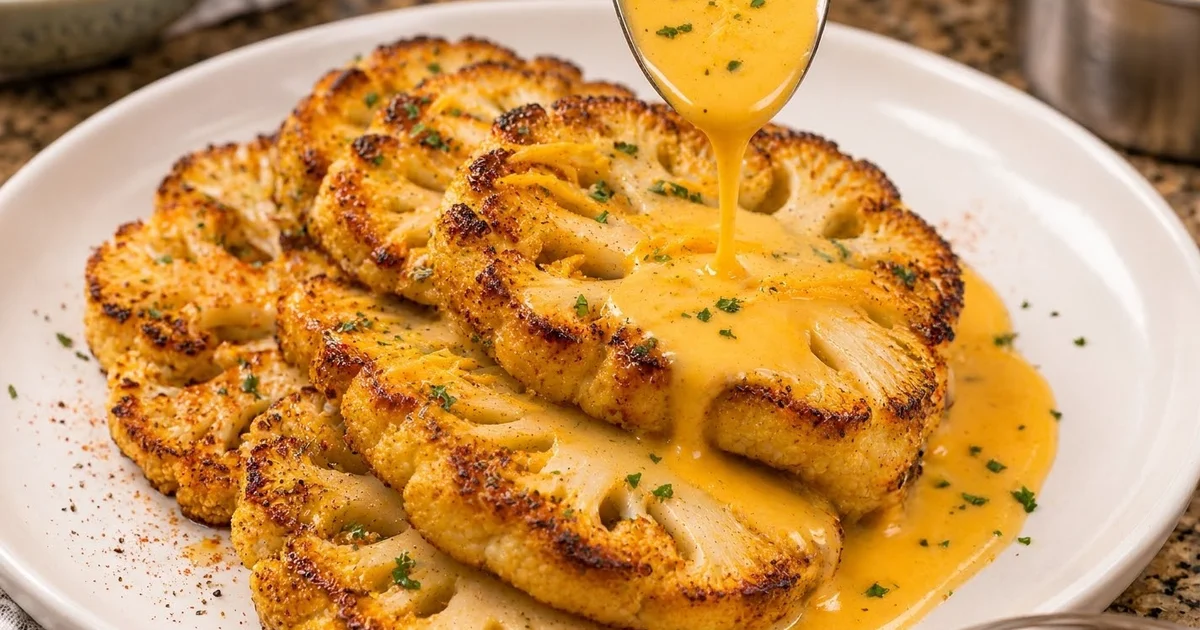
Cauliflower steaks are what you get when you slice a whole head of cauliflower straight through the core into thick slabs, the way you would cut a loaf of bread. You don’t break it into florets. The slabs hold together, brown beautifully, and make a vegetable side look like the main event. Here they’re seared and roasted until golden, then covered in a silky cheddar cheese sauce.
The flavor is deeply savory and a little nutty. Roasting turns cauliflower’s mild, grassy taste sweet and toasty, especially at the dark, crispy edges. The centers stay tender but still hold their shape. Then the cheese sauce goes on: warm, creamy and sharp, filling every nook between the florets. A scatter of fresh parsley adds a bright, green finish.
For home cooks, this recipe is very forgiving. It takes one skillet, one small saucepan and about 40 minutes start to finish. You don’t need special skills, just a sharp knife and a little patience while the steaks brown.
It works for a meatless weeknight dinner, as an impressive side for a holiday table, or for anyone eating vegetarian, low-carb or gluten-free (use the swap noted below). Kids who say they don’t like cauliflower often change their minds once cheese sauce is involved.
Why This Recipe Works
Searing before roasting gives the best color. Cauliflower has a lot of water in it, so if it only goes into the oven, it tends to steam before it browns. Starting the steaks in a hot, oiled skillet kicks off caramelization right away, and you get those deep golden, almost charred edges. A short finish in the oven then cooks the thick core through without burning the surface.
Cutting through the core keeps the steaks whole. The stem is what holds each slab together. Cut steaks about ¾ inch (2 cm) thick from the center of the head: thick enough to stay intact when you flip them, thin enough to cook through in about 20 minutes.
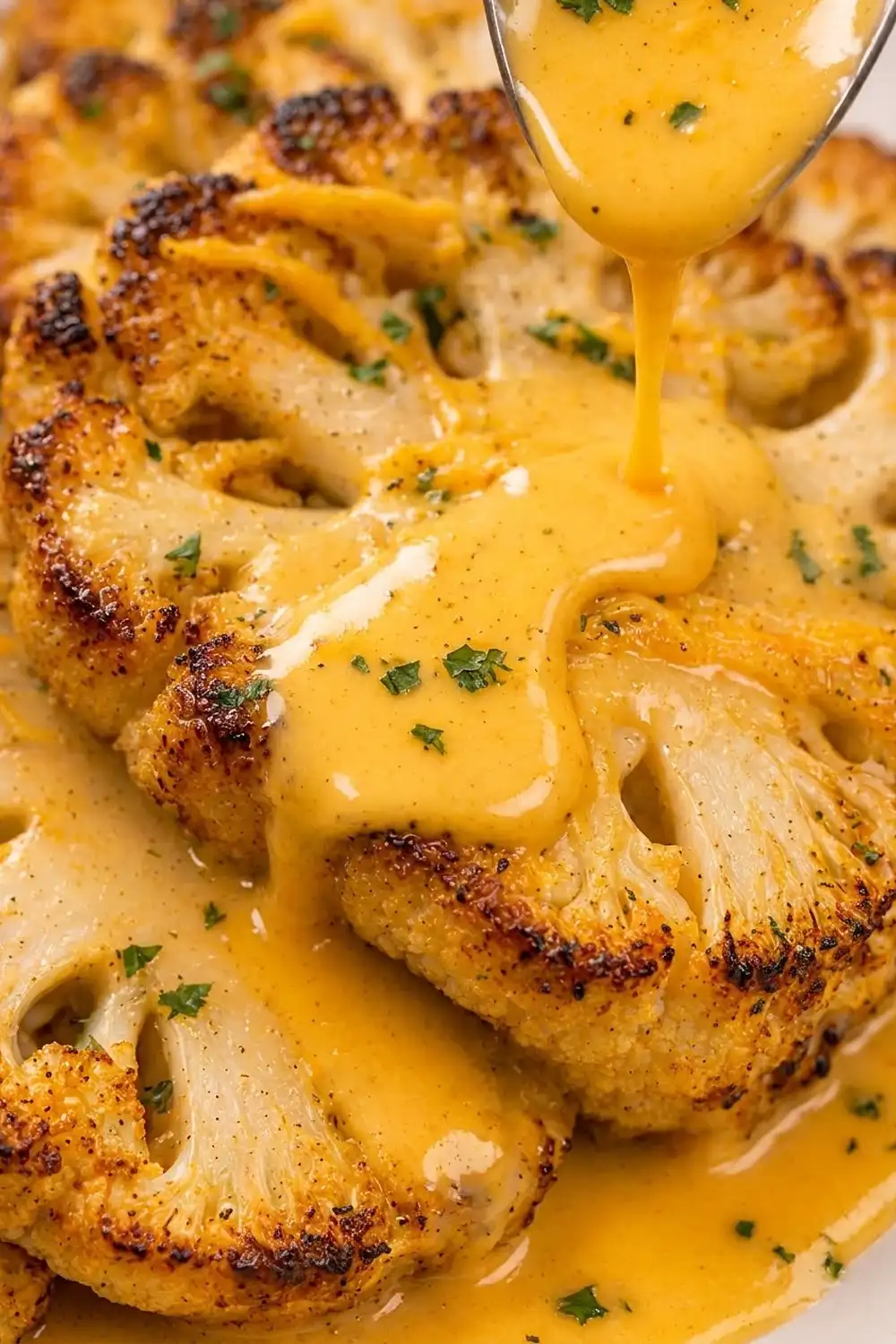
A simple roux sauce stays smooth. Cooking butter and flour together, then whisking in warm milk, gives a stable base that holds the cheese without turning grainy. Taking the pan off the heat before you stir in the cheddar stops the cheese from overheating and separating. That’s how you get the glossy, pourable sauce in the photo.
Tips for Success
- Choose large, tight heads. Big, dense cauliflower with a sturdy stem gives you more usable steaks and holds together better.
- Dry the cauliflower thoroughly. Wet cauliflower steams instead of searing. Pat it dry even if you rinsed it hours earlier.
- Don’t crowd the pan. Sear in batches if you need to. Overcrowding drops the pan’s temperature and you lose the golden crust.
- Warm the milk first. Microwaving it for 45–60 seconds helps it blend into the roux smoothly, with fewer lumps.
- Use sharp cheddar. Mild cheddar tastes flat against roasted cauliflower. Sharp or extra-sharp gives a punchier, tangier sauce.
- Make the sauce ahead. Refrigerate it up to 3 days and rewarm gently with a splash of milk, whisking until smooth.
- Use the leftover florets. Roast them on the same sheet pan alongside the steaks so nothing goes to waste.
Variations
Smoky version: Swap the sweet paprika for smoked paprika in both the rub and the sauce. It adds a light, bacon-like depth without any meat, and works especially well with a sharp white cheddar.
Spicy cheese sauce: Stir ⅛–¼ tsp cayenne or 1 tsp hot sauce into the finished sauce. The heat cuts through the richness and makes the dish feel bolder. Taste as you go.
Different cheese blend: Replace half the cheddar with Gruyère or Monterey Jack. Gruyère adds a nutty, Alpine flavor. Jack melts extra smoothly and tastes milder for picky eaters.
Crunchy topping: Toss ¼ cup (15 g) panko with 1 tsp melted butter and toast it in a dry pan until golden. Sprinkle it over the sauce right before serving for crunch.
FAQ
Why are my cauliflower steaks falling apart?
Usually the slices were cut too far from the center, where there’s no core to hold them together. Use only the 2–3 middle slices from each head, and flip them with a wide spatula. If one breaks, roast the pieces anyway. They’ll taste just as good.
Can I make these entirely in the oven?
Yes. Roast the seasoned steaks on a parchment-lined sheet pan at 425°F (220°C) for 25–30 minutes, flipping halfway through. They’ll brown less dramatically than seared steaks, but still turn golden and tender. Heat the empty sheet pan in the oven first for better color.
My cheese sauce turned grainy. What happened?
Most likely the sauce was too hot when the cheese went in, or you used pre-shredded cheese with anti-caking coatings. Always take the pan off the heat before adding cheese. A small splash of warm milk whisked in can sometimes save a slightly broken sauce.
Is this dish low-carb or keto-friendly?
The cauliflower itself is very low in carbs. For a lower-carb sauce, skip the flour, simmer ½ cup (120 ml) heavy cream with ¾ cup (180 ml) milk until slightly reduced, then melt in the cheese. It will be a little looser but still creamy.
Can I use frozen cauliflower?
Not for steaks. Frozen cauliflower is already cut into florets and holds too much water to sear well. Fresh whole heads are essential for the steak shape and the browned crust.
Storage and Reheating
Store leftover steaks and sauce in separate airtight containers in the refrigerator for up to 3 days. Keeping them apart helps the cauliflower keep some of its texture instead of soaking up the sauce and going soft.
To reheat, put the steaks on a sheet pan in a 400°F (200°C) oven for 8–10 minutes, until hot and the edges crisp up again. An air fryer at 375°F (190°C) for 5–6 minutes also works well. Rewarm the sauce in a small pan over low heat with 1–2 tbsp milk, whisking constantly, or microwave it in 20-second bursts, stirring between each.
Cooked cauliflower steaks don’t freeze well. They turn watery and mushy when thawed. The cheese sauce can be frozen for up to 2 months, though it may separate a little. Thaw it overnight in the refrigerator, then reheat gently while whisking hard to bring it back together.
Serving Suggestions
As a main course, serve these steaks with a crisp green salad dressed in a lemony vinaigrette. The acidity balances the rich cheese sauce. A side of fluffy rice or quinoa soaks up any extra sauce and makes the meal more filling.
As a side dish, they go well with roast chicken or grilled pork chops, which match the dish’s savory, golden flavors. For a cozy dinner, add crusty bread to mop up every last bit of cheddar from the plate.
Final Notes
Roasted cauliflower steaks with cheddar cheese sauce prove that a humble vegetable can be the star of the table. The keys are simple: cut thick slabs through the core, dry them well, sear them hard and finish them in the oven, then make the sauce gently, off the heat. Once you’ve made it once, you’ll know the timing by feel, and it will become a dependable recipe for busy weeknights and special dinners alike. Grab a sharp knife and a good block of cheddar, and enjoy every golden, cheesy bite.
Print
Roasted Cauliflower Steaks with Cheddar Cheese Sauce Recipe
- Total Time: 40 minutes
- Yield: 4 (1–2 steaks each) 1x
Description
Thick-cut cauliflower steaks seared and roasted until golden, then smothered in a smooth, sharp cheddar sauce. An easy vegetarian dinner or a standout side.
Ingredients
- 2 medium heads cauliflower (about 2 lb / 900 g each)
- 3 tbsp (45 ml) olive oil or avocado oil, divided
- 1 tsp (6 g) kosher salt
- ½ tsp (1 g) freshly ground black pepper
- 1 tsp (2 g) paprika
- ½ tsp (1.5 g) garlic powder
- 2 tbsp (28 g) unsalted butter
- 2 tbsp (16 g) all-purpose flour
- 1¼ cups (300 ml) whole or 2% milk, warmed
- 1½ cups (170 g) sharp cheddar, freshly shredded
- ¼ tsp (0.5 g) paprika
- ¼ tsp (1.5 g) kosher salt, or to taste
- ⅛ tsp (0.3 g) black pepper
- 2 tbsp (8 g) fresh parsley, finely chopped
Instructions
- Prep and slice the cauliflower. Heat the oven to 425°F (220°C). Pull off the outer leaves and trim the stem flat so each head stands upright without wobbling. Starting at the center, cut straight down through the core to make ¾-inch (2 cm) slabs, about 2–3 per head. Each steak should be one connected piece with the stem visible in the middle. The most common mistake is cutting too close to the edge. Those outer slices have no core and fall apart, so set them aside for roasting as florets.
- Season the steaks. Pat the steaks completely dry with paper towels. Surface moisture stops browning. Brush both sides with 2 tbsp of the oil. Mix the salt, pepper, paprika and garlic powder in a small bowl, then sprinkle it evenly over both sides and press it gently into the surface. Done right, you’ll see an even reddish dusting with black pepper specks all over. Don’t pile the seasoning in the middle and leave the edges bare. The edges are where the most flavorful browning happens.
- Sear until golden. Heat the remaining 1 tbsp oil in the skillet over medium-high heat until it shimmers, about 2 minutes. Add two or three steaks without crowding them. You should hear a steady sizzle. Leave them alone for 3–4 minutes, until the underside is deep golden with dark, crispy edges, then flip carefully with a wide spatula. If you move them too soon, they stick and tear. If the oil starts smoking, turn the heat down a little.
- Roast to finish. After flipping, put the whole skillet in the oven, or move the steaks to a sheet pan if you’re cooking in batches. Roast 15–18 minutes, until a paring knife slides easily into the thickest part of the core. The kitchen will smell nutty and toasty, and the edges will look caramelized and a little charred in spots. Don’t pull them early. An undercooked core is crunchy and tastes raw, even when the surface looks finished.
- Make the cheese sauce. While the steaks roast, melt the butter in the saucepan over medium heat. Whisk in the flour and cook for 1 minute, until it bubbles and smells lightly toasty but hasn’t browned. Slowly pour in the warm milk, whisking constantly, then simmer 2–3 minutes until the sauce coats the back of a spoon. Take the pan off the heat and stir in the cheddar a handful at a time, then the paprika, salt and pepper. Adding cheese over high heat is the classic mistake. It turns the sauce oily and stringy.
- Spoon over and garnish. Stack the roasted steaks, slightly overlapping, on a warm serving plate. Spoon the hot cheese sauce over the centers and let it run down into the crevices and pool around the base. It should be thick and glossy, flowing in a slow ribbon off the spoon. If it’s too thick, whisk in 1–2 tbsp of milk. Scatter the parsley over the top and serve right away, while the edges are still crisp.
Notes
- Choose large, tight heads. Big, dense cauliflower with a sturdy stem gives you more usable steaks and holds together better.
- Dry the cauliflower thoroughly. Wet cauliflower steams instead of searing. Pat it dry even if you rinsed it hours earlier.
- Don’t crowd the pan. Sear in batches if you need to. Overcrowding drops the pan’s temperature and you lose the golden crust.
- Warm the milk first. Microwaving it for 45–60 seconds helps it blend into the roux smoothly, with fewer lumps.
- Use sharp cheddar. Mild cheddar tastes flat against roasted cauliflower. Sharp or extra-sharp gives a punchier, tangier sauce.
- Make the sauce ahead. Refrigerate it up to 3 days and rewarm gently with a splash of milk, whisking until smooth.
- Use the leftover florets. Roast them on the same sheet pan alongside the steaks so nothing goes to waste.
- Prep Time: 15 minutes
- Cook Time: 25 minutes
- Category: Vegetarian